
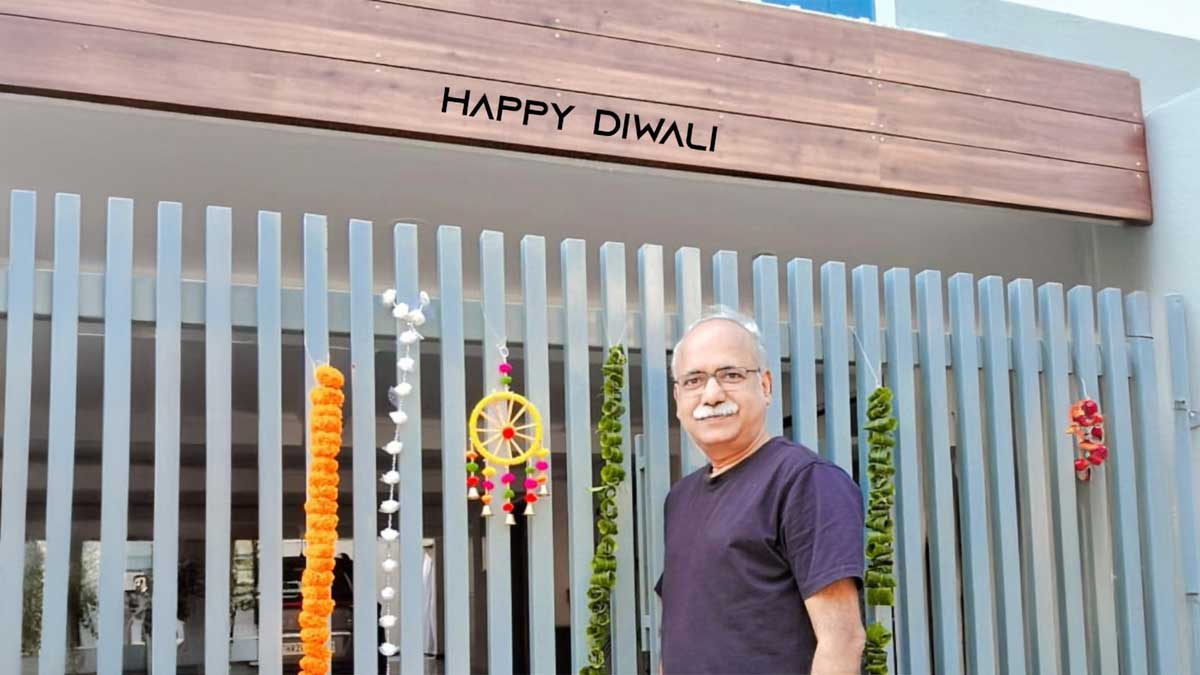
It is Sunday evening today. Tomorrow is Diwali – the festival of lights, joy, and togetherness. As I sit quietly in my room, I am drawn into the stream of my own memories, flowing backwards through the years.
My mind travels through the Diwalis of my life – from the faint glimmers of early childhood to the digital flickers of today. It feels as if every light I once lit is still glowing somewhere within me.
I cannot remember Diwali when I was three or four years old. There is no image, no sound, nothing in my memory cells from those early days. But a little later, when I was a small boy, I do remember that we used to celebrate Diwali with the simplest of joys – those tiny bindi-wale patakhe and that small toy pistol that fired rolls of them, one by one, with a small spark and sound.
The bigger crackers frightened me then. I used to cover my ears or hide behind the wall whenever someone lit a ladhi or a bomb. The smell of burnt paper, the smoke, and the laughter around still echo faintly inside me.
Those were innocent times.
The sweets too were simple – burfi, gulab jamun, rasgulla, balushahi – not like the modern times when shops overflow with hundreds of varieties, some even foreign, continental, decorated like jewels. In those days, even a small piece of burfi felt like a reward.
As I grew up and entered my senior secondary school – Ramjas School No. 4, Paharganj – Diwali brought another flavour of fun. I still remember how the air around the school used to smell of crackers and smoke.
The boys in school were full of energy and mischief.
Sometimes, during classes, someone would light a small cracker under the bench, and the whole class would burst into laughter and chaos while teachers scolded us.
After school hours, the playground became a small carnival – everyone showing what crackers they brought, who had the louder one, and who had the colourful one.
There was no comparison, no competition – only laughter, friendship, and the shared excitement of the festival.
During my adolescent years, I learned something new – how to make anars myself. It was at my mausi’s house that I first learned this from my cousins.
It was such a fascinating experience.
We used to go to Badi Sabzi Mandi in Paharganj, behind Panchkuin Road – the same place where today the Ramakrishna Mission Ashram metro station stands – to buy the raw materials. That market had everything – powders, scrap metals, and small earthen pots.
We were like little scientists, experimenting with fire and colours.
We discovered that the kind of metal scrap we used decided the colour of the sparks – iron scrap made yellow sparkles, copper scrap gave greenish-blue sparks, zinc scrap gave silvery-white ones, and other metals created many other hues.
The mixture had to be perfect, not too tight, not too loose.
Those homemade anars were our pride.
They lasted longer than the market ones and rose higher, glowing beautifully with colourful sparkles that reached towards the sky.
Our neighbours and children of our age would stand in curiosity and admiration, wondering if we were making our special anars that year again.
Gradually, two of my school friends joined me – Surjit, who later became a chartered accountant, and Indersain, who later became an accountancy coach. Surjit would always buy double the materials because soon after Diwali, Guru Nanak Dev Ji’s birthday was celebrated, and he needed more anars for that festival too. Indersain would travel all the way from Rani Bagh to be part of our small team.
For five or six years, we continued this tradition – mixing powders, filling earthen pots, testing the burn, and celebrating together. Those evenings spent preparing and the nights spent lighting those anars were pure joy.
They were lessons in friendship, creativity, and youthful curiosity.
Then came my college years at Nehru Homoeopathic Medical College, Delhi.
Diwali brought a different kind of happiness.
My friend PD, who is now an anesthesiologist in the USA, had a motorbike. He used to pick me up, and we would roam around Connaught Place, Minto Road, and Gole Market – watching lights, buying sweets, and feeling free.
Those were the golden days of student life – full of dreams and possibilities. During internship, one Diwali was spent in the Doctor’s Duty Room, the DDR, at NHMC. We were on call, but still found ways to celebrate – a few candles on the table, some sweets shared among interns, laughter over tea. That small celebration in the DDR remains one of my fondest memories because it symbolised togetherness even in duty, warmth even in work.
After completing college, life entered a new phase. I started my clinic. Diwali now meant something else. It became more formal. I had become a doctor. Patients, responsibilities, and social image came naturally with the profession. I could no longer run in the streets with crackers in my hands.
My celebrations became quiet, measured, polite – exchanging sweets, greeting families, and keeping the light alive in a more mature way. Somewhere in those years, childhood’s carefree Diwali turned into adulthood’s dignified one.
Then came marriage – a new chapter, a new home, and later, a new city – Gurgaon. The surroundings changed, neighbours changed, and yet Diwali remained the common thread that connected everyone. We celebrated with our new neighbours, shared sweets, and exchanged gifts. There was joy, but it carried a calm maturity now.
With my daughter, Diwali regained its colour. There was rangoli at home, small firecrackers, and laughter in the house. I remember her excitement while lighting the phuljhadis and making small designs on the floor. Her joy filled my heart with warmth. Through her eyes, I saw my own childhood again. The house glowed not just with lamps, but with the soft light of love.
But as time moved forward, things changed again. The pace of life quickened, and the essence of Diwali began to shift. The celebrations became shorter, quieter. The physical togetherness was replaced by digital closeness. Now, Diwali often means sending messages, sharing emojis, or posting greetings on social media. The sound of real laughter has turned into the ping of a notification. The fragrance of sweets is replaced by images of them on screens. The light remains, but its warmth feels different.
And then, not all Diwalis were celebrations. One year during the Covid-19 pandemic, we were ourselves suffering with fever and weakness during Diwali days. Those days taught me that Diwali is not only about lights – it is also about hope, faith, and endurance.
There was another Diwali when we attended the cremation of a distant family member. The day reminded me how fragile life is, and how even in the festival of lights, shadows of grief can appear. Yet, each time, after every dark Diwali, there came another one that brought back light – maybe dimmer, maybe quieter, but always there.
Now, sitting here tonight, I look back and realise that Diwali has been a mirror of my life itself. In every stage – childhood, school, college, profession, family, and now reflection – the festival has shown me who I was at that time.
From the small boy afraid of loud crackers to the man who now prefers the soft glow of a single diya – the journey has been long and meaningful. Every Diwali, in its own way, has shaped my understanding of joy, togetherness, and life.
When I look outside now, I can see lights being strung on balconies, children running with sparklers, and families shopping in the streets. And yet, inside me, the most beautiful Diwali is the one that lights up in my memories – the laughter of friends, the glow on my daughter’s face, the smiles of patients who got better, and the quiet evenings when I simply sat and watched the flame of a lamp. That small flame, steady and calm, feels like the reflection of my own being.
Diwali has changed – from the noise of crackers to the silence of thought, from sweet boxes to text messages, from busy gatherings to quiet reflections – and yet, its soul remains untouched. It is still about lighting something within, even when everything outside grows dark. It is still about sharing warmth, even when distances grow wide.
So, as I sit here and write, I want to speak directly to you – my reader, my companion in thought. Wherever you are, whatever stage of life you are in, light your own small lamp this Diwali – not just outside your home, but inside your heart.
Let it remind you of the good days, guide you through the difficult ones, and fill your present with hope. May your Diwali bring health, peace, and quiet joy.
Happy Diwali – from my heart and home to yours.