
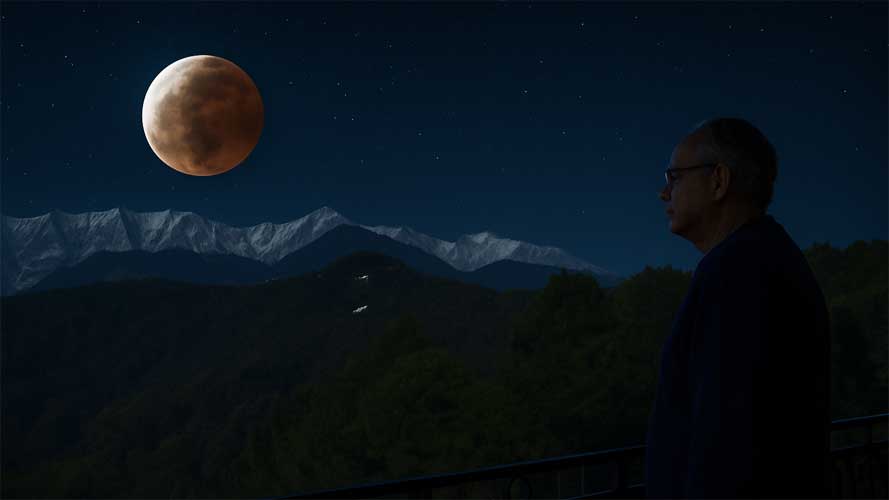
Today, I find myself reflecting on the eclipse. Since childhood, the very word ग्रहण has carried unease. Whenever news of an eclipse spread, elders warned us it was inauspicious. We were told to stay indoors, to avoid food, to pray. ग्रहण लगना meant something unwanted, something that fell upon a person like a shadow. For them it was not a cosmic wonder but a period of danger — a pause of light that could unsettle life.
In school, however, I encountered it differently. Teachers explained it with enthusiasm, using a lamp, a globe, and a ball to show how shadows moved, how light was covered, how alignment created darkness. There was no fear in that demonstration, only curiosity and the realisation that the universe was vast, precise, and orderly. The eclipse was not a curse; it was geometry. Not inauspicious, but predictable. These two impressions — cultural fear and scientific clarity — both entered me as a child. And today, as I sit by the window on this Sunday evening, hearing of tonight’s lunar eclipse, I realise both streams lead me to the same thought: the eclipse is not only in the sky; it is also within me.
An eclipse outside is a play of light and shadow. Within, it is no different. Across six decades, I have lived through many inner eclipses of thought and emotion. There were times when clarity shone brightly, when purpose was strong, and I walked with conviction. But there were also times when something moved across that inner Sun — a doubt, a hesitation, an unresolved question, a burden I could not carry. There were moments of guilt for words unspoken, regret for choices made, helplessness in the face of loss, shame for mistakes I could not undo. At times, anger clouded judgment; at others, fear paralysed me. Sometimes it was loneliness that cast its long shadow, sometimes betrayal, sometimes despair. The light dimmed, and life felt like twilight. Decisions that once seemed simple grew heavy, and even hope appeared fragile. In those moments, I felt what elders warned me of: ग्रहण लगना — not to the Moon or the Sun, but to myself.
Not all eclipses were alike. Some were fleeting, like a penumbral eclipse so subtle one might miss it. These were minor hesitations — a delayed word, a passing doubt, a momentary conflict — gone before they left a scar. Others were long, like total eclipses. They stretched over months or even years, when responsibilities grew so heavy they choked joy, when anxieties piled up until sleep itself became restless, when failures seemed louder than successes. There were times when financial uncertainty weighed me down, when the illness of a loved one tested my faith, when disappointments in relationships left me empty. At such times, I felt suspended in half-light, trapped in a silence I could not break, waiting for dawn to return. Yet through it all, one truth endured: the light was never lost. It was only hidden.
The traditional view of ग्रहण taught me caution. When clarity is dimmed, move carefully. Decisions made in shadow often need revisiting when light returns. That caution remains valid. But science gave me another truth: shadows are temporary, part of a rhythm, never the end. From these two perspectives emerged a deeper lesson. The shadow is not only something to fear; it is also something to learn from. In darkness, I discovered resilience. In doubt, I learned patience. In helplessness, I found humility. In failure, I found renewal. These qualities — patience, humility, resilience — are like the Sun’s corona revealed only in eclipse, invisible in ordinary times but radiant in shadow.
Astronomy tells us that an eclipse requires alignment. The Sun, Earth, and Moon must fall in line before one can cast its shadow on another. Life too creates its alignments. A personal loss, a financial burden, an illness, a disappointment, a crisis of faith — when they arrive together, they can eclipse the inner sky. We may feel trapped in suffocating darkness, betrayed by time, abandoned by luck. But perhaps these alignments are not accidents. Just as celestial eclipses remind us of cosmic order, inner eclipses remind us of life’s hidden design. They force us to pause, to look inward, to face our fragility and to recognise our strength.
Tonight, millions will watch Earth’s shadow crawl across the Moon. Some will marvel, some will pray, some will remember old fears. And then, slowly, the shadow will pass. The Moon will return to fullness. Life will go on. So it is with us. Our shadows — whether of fear, loss, regret, failure, or despair — do not last forever. Time carries them away. And when the light returns, it feels brighter because of what it has endured.
Looking back, I see that the childhood view of ग्रहण was not wrong, only incomplete. Yes, eclipses bring unease. When light is hidden, we feel anxious, weak, and restless. But anxiety is not annihilation; weakness is not permanent. Science gave me the other half: eclipses are temporary, predictable, part of a larger rhythm. Together, they reveal the truth. ग्रहण is not only a fearful interruption but also a reminder — shadows are real, but so is the enduring presence of light.
And so, if you are reading this, you may recall moments when a ग्रहण seemed to fall upon your own life — when fears gripped you, when mistakes haunted you, when loneliness stung, when responsibilities felt unbearable, when hope seemed distant. Let me assure you: such moments are not signs of failure but of being human. They mean your inner cosmos is alive, moving, tested by alignments beyond your choosing.
And as I sit on this Sunday evening of September 7th, 2025, watching the lunar eclipse, I feel I am watching the story of my own life — a story of light and shadow, of loss and renewal, of fear and courage, of temporary darkness and enduring brightness. The elders who taught me caution and the teachers who revealed scientific beauty were both right. Together, they prepared me for the eclipses within. They taught me that shadows come and go, but the light within remains constant.
Do not fear the shadow. It is only passing. What endures, always, is the light.