
Walking the Path of Hahnemann with Dignity : A Tribute to the Master and a Message to the Next Generation
Tomorrow, the world will mark 270 years since the birth of Dr. Samuel Hahnemann. For most, he is the founder of homeopathy. For me, he is much more. He is the reason I have survived as a doctor, lived with dignity, and walked a path that tested me again and again—and yet, never broke me.
Tonight, as I sit quietly and reflect on this occasion, I feel it is not enough to simply garland his photo or speak in admiration. I must speak my truth. I must say aloud what I’ve lived in silence for decades. And perhaps, somewhere, a young homeopath will read this and feel seen, heard, and strengthened.
The word mission has been with me since my earliest days in this field. It greeted me in the very first line of the Organon—“The physician’s highest and only mission is to restore the sick to health.” At that time, I was a BHMS student with more idealism than experience, and this sentence moved me deeply. I felt like I had been entrusted with something sacred. That I was not entering a profession, but a purpose. There was no talk of money, success, or recognition—just healing. Just service.
But no book prepares you for the world outside the college gates.
When I passed out in 1989, I was full of enthusiasm. I rented a small room and opened my first clinic. The board was new. My table was neatly arranged. My heart was open. I believed that if I practiced sincerely, patients would come.
They didn’t.
Days passed, sometimes without a single consultation.
I shifted clinics. Tried new localities. Each time I hoped the tide would turn.
Each time it didn’t.
There were evenings I returned home ashamed. I had spent the entire day waiting, reading, thinking—but earning nothing.
Friends who had taken other paths were doing well. Some had gone abroad. Some had landed in secure jobs.
I had no fallback plan—just this stubborn love for homeopathy, and a quiet belief that one day it would carry me forward.
There’s a kind of poverty that isn’t material—it’s the poverty of being unseen. I knew I had studied hard, I knew I had depth, but the world didn’t know it. And worse, it didn’t care. Patients came, sometimes, but not consistently. Some came because I was the cheaper option. Others came and didn’t return. I took it all to heart.
I doubted my prescriptions, my methods, my worth. Still, I returned to my books, to Boger, to Kent, to Boenninghausen, to Hahnemann. Their words were like a thread I could hold onto when nothing else made sense.
But hope can only survive so long when it’s unsupported by stability.
I realized I couldn’t build anything permanent while being pushed from one rented clinic to another.
I needed to take root. I needed to commit to one place, fully. And so, I did the most difficult thing I have ever done in my life—I sold my own house to buy a permanent space for my clinic.
People were shocked. They thought I had lost all sense. And maybe, in a way, I had. Because I was no longer thinking with logic. I was thinking with faith. I had given my youth, my trust, and my loyalty to homeopathy. And if I didn’t take this leap now, I would spend the rest of my life half-committed, half-respected. I needed a clinic that was mine. A space where I didn’t have to look over my shoulder or worry about rent hikes or closures. I needed a place where my mission could finally find a home.
That small market clinic became my temple. I arranged my books with reverence. I framed Hahnemann’s photo again and hung it on the wall—not as decoration, but as witness. And I made a quiet promise to him that day: I will serve, with all I have, but I will not surrender my dignity. Not to poverty. Not to public perception. Not to misplaced expectations.
That promise has been tested many times over the years. And one of the greatest challenges has come not from disease or difficulty, but from a mindset that still exists—especially in India—that homeopathy is missionary work, and homeopaths are expected to do charity.
There have been countless moments in my practice when wealthy individuals—people who live in mansions, wear luxury watches, travel the world—come to my clinic and say, “Doctor saab, please treat our driver or maid for free. They are poor.” Now, of course, the driver is poor. The maid is struggling. I feel for them. But why must I be the one to bear that responsibility? Why doesn’t the rich man pay for their treatment as he pays for their food, their clothes, their Diwali bonus?
This is not compassion. This is moral outsourcing.
It is a disguised expectation of charity, placed not on the person with wealth, but on the person with a healing art. And this is where the confusion begins—because people believe that homeopathy is a charity, and homeopaths are bound to serve without seeking fair compensation.
They think we are missionaries—not physicians.
And this is where we must remember what mission truly means.
Mission does not mean martyrdom.
Mission does not mean surrender.
Mission does not mean free service for all.
Mission means responsibility.
It means excellence.
It means restoring health with care, skill, and depth.
Even Hahnemann understood this.
But for now, let me say this to every patient who thinks we must serve without asking anything in return: we are not running a temple. We are running a clinic. We are not asking for donations—we are offering knowledge, time, experience, and empathy. And like every other professional, we deserve to sustain ourselves and our families. We deserve to earn—not extravagantly, but honestly, fairly, and with dignity.
I have lived this truth. I have struggled through it. And I have earned the right to speak it—not with anger, but with clarity.
Some may think I speak this way out of personal frustration. But let me say—my views are not born of bitterness. They are rooted in history. In truth. In the very legacy of Hahnemann himself. Because before I ever charged a fee with firmness, before I ever stood my ground against misplaced expectations, I asked myself: What would Hahnemann have done?
And the answer came—not from imagination, but from his own pen.
On May 19, 1831, Hahnemann wrote a letter to his close colleague, Dr. Rummel. In that letter, he addresses something few people today talk about—title, fee, and the value of a homeopath’s time and skill. This was not Hahnemann the philosopher speaking—it was Hahnemann the practicing physician, aged 76, writing from experience, with remarkable clarity. Let me quote his own words here:
“It is advisable for the homeopathic physician to set a very much higher value on his so infinitely superior science of healing, so as to procure for himself better fees, or at least to put chronic patients on a settled monthly fee (preferably paid in advance), and to make the poorer patients pay a small sum each time, if it were only a few groschen—accipe dum dolet [Take while it hurts].”
How astonishingly modern this is. In a time when many think Hahnemann was an ascetic, indifferent to material concerns, here he is—advising physicians to place a high value on their services, to be paid in advance, and to charge even the poor something, no matter how small, because it preserves mutual respect.
And then comes the most profound line:
“Only in this way is it possible for the physician to avoid loss, and keep up his courage by seeing some actual money for his trouble.”
These words spoke directly to me when I first read them. Keep up his courage—how beautifully human that is. Because when we see our efforts rewarded, our hearts stay alive. When we are compensated fairly, our mind remains clear. And when we are treated as professionals, we rise to higher levels of excellence. Even Hahnemann knew that free service without structure leads to fatigue, loss, and resentment.
He continues:
“What he has given gradually has passed out of his mind and the physician has received his due, in this way it passes from the patient’s purse into that of the doctor without causing displeasure.”
This is not just economics. It is ethics, psychology, and human wisdom. When patients pay fairly—regularly, predictably, and according to their means—they don’t feel burdened, and neither does the doctor. There is no friction. There is no confusion. There is just harmony.
But Hahnemann’s message doesn’t end there. After years of facing opposition, ridicule, and professional isolation, he made a bold move at the age of 80. He left Cöthen and moved to Paris, the cultural heart of Europe. And in that city, his practice flourished beyond imagination.
In Paris, Hahnemann treated royalty, aristocrats, artists, diplomats. His clientele was elite—and they respected him not as a curious alternative doctor, but as a master of his art. They paid him handsomely, and he accepted it—not as greed, but as recognition. He lived in comfort and dignity, not in penance or poverty.
This is important. Because it destroys the myth that Hahnemann was a monk-like figure offering free treatment to the masses. Yes, he was a man of compassion. Yes, he was driven by a mission. But he never compromised the value of his time, his training, or his method.
So I ask again: Why should we?
Why should modern homeopaths be made to feel guilty for seeking proper fees?
Why should we be expected to give free treatment at the behest of those who can afford to support their own staff?
Why is our science—refined, rigorous, and deeply intellectual—still seen by some as a public charity, not a professional discipline?
This distortion must end. And it can only end when we speak openly—when we remind ourselves and our patients that mission and charity are not the same.
Mission is a responsibility—to heal with skill and sincerity.
Charity is a choice—to serve freely when one has the means and space to do so.
But charity cannot be demanded, especially not by those who will not part with their own money. And mission cannot be fulfilled if the doctor himself is struggling to survive, to feed his family, to pay his bills, to sustain his clinic.
In Paris, Hahnemann’s mission was at its most powerful—not because he charged less, but because he was valued as he deserved to be. His mind was free to serve, because his basic needs were met with respect. And that is the model we must remember.
So when people say, “Doctor saab, please treat our servant free, he is poor,” I want to ask gently—Will you pay his fee then? If you care, will you take the burden? Or is your charity only valid when someone else does the giving?
And I want young homeopaths to hear this—you are not selfish for charging fees. You are not unkind for protecting your energy. You are not wrong for expecting fairness. You are building something. You are learning. You are healing. And you have every right to live with dignity.
After those early years of struggle—shifting clinics, selling my home, battling self-doubt—something began to change, not in the world around me, but within me.
I began to grow—not just as a practitioner, but as a person who had learned to endure. The clinic I had built, modest as it was, slowly started to carry an energy of its own. There was still no grandeur, no banners, no waiting lists. But there was consistency. Quietly, steadily, people began to come. Some returned. Some sent others. And over time, the silence that once filled my consultation room began to give way to stories—stories of suffering, of hope, of healing.
It was never about the numbers for me. It was always about depth. I gave each case everything I had. I sat with patients, listened deeply, observed quietly, studied relentlessly. And in the process, something beautiful unfolded. I began to realize that homeopathy is not just a medical system. It is a way of seeing the human being. It is the art of perceiving suffering beneath the surface—beyond symptoms, beyond pathology, into the emotional fabric that weaves a person’s experience of disease.
I began to notice how illness was not isolated—it was connected to memories, fears, longings, unresolved grief. A woman’s migraines were linked to her silence in marriage. A child’s asthma traced back to an early separation from the mother. An old man’s skin disease carried the imprint of humiliation he had never voiced. And suddenly, I was no longer just a doctor. I was a witness to stories that hadn’t been told. My remedies became more than prescriptions—they became acts of recognition. Acknowledgments of suffering that no one had named before.
And as I went deeper into this process, I began to feel a sense of companionship—not from patients, but from those who had walked this path long before me. The figures I had once read about—Boenninghausen, Kent, Boger—were no longer historical names. They became silent mentors. And above all, I felt Hahnemann watching—not judging, not instructing, just witnessing, with the gentle strength of a teacher who trusts the journey of his student.
This was around the time I immersed myself in the writings of Dr. C. M. Boger. There was something about his mind that fascinated me. He was not just a compiler of data—he was a thinker, a synthesizer. He saw the interconnectedness of the symptom, the modality, the pathology, the constitution. He didn’t separate the clinical from the philosophical. He didn’t divide materia medica from repertory. And in him, I found a kind of intellectual kinship—a bridge between classical homeopathy and the evolving demands of clinical practice.
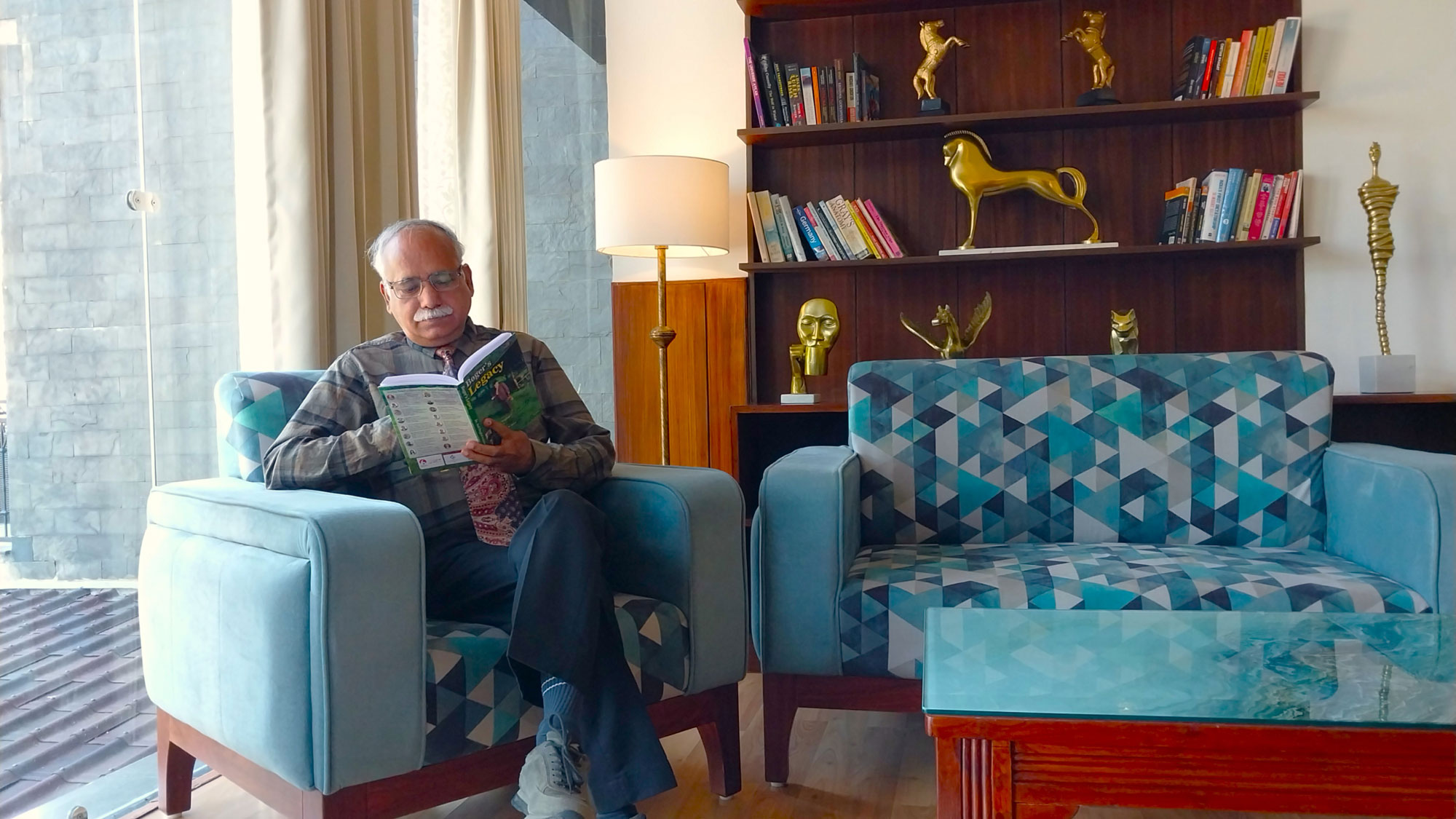
It was then that the seed of Boger’s Legacy began to take shape. Not as a book, initially. Just a collection of reflections, notes, interpretations. But the more I wrote, the more I realized that I wasn’t just documenting his work—I was entering into a dialogue with it. I was asking questions, and he was answering—not directly, but through the patterns in his work, the clarity in his case-taking, the consistency in his logic. And soon, I knew: this had to be shared. Because somewhere out there was another struggling homeopath, staring at an unread book on a dusty shelf, not knowing that within it lay a treasure that could change everything.
Writing Boger’s Legacy was not about academic pride. It was an offering. A gesture of gratitude—to Boger, to Boenninghausen, to Hahnemann. It was also a letter to the future. A message to young doctors: You are not alone. You are walking a path that has been walked before. And every time you open a book with sincerity, you are not studying—you are entering into a living conversation across time.
I realized then that we often confuse charity with generosity. True generosity is not about giving away everything for free. It is about giving with awareness, with discernment, with balance. As my practice stabilized, I found myself helping more people—not because I was pressured to do so, but because I had reached a point where I could. It came from choice, not compulsion. From abundance, not scarcity.
That’s what we must understand: Charity is not the beginning. Charity is the fruit.
In my early years, I had nothing to give. I could barely hold myself together. But I was still expected to serve like a saint. That was not charity. That was exploitation, dressed in the language of moral nobility. But now, years later, when I could afford to offer help, it became genuine. And it flowed not from guilt, but from a deep sense of connection.
When I help someone, I do it with full heart—not because they or their employer expects it, but because I choose to honor their suffering. And because I know my own stability is not shaken by that choice.
This, to me, is the evolution of a true physician.
You start with fire, pass through darkness, find your center, and then radiate light—not for the world to see, but for those who truly need it. And in that light, you don’t lose yourself. You don’t dissolve into charity. You rise into your mission.
And that mission, as Hahnemann said, is to restore the sick to health. Not to abandon your own. Not to deplete your family’s comfort for someone else’s sense of morality. Not to apologize for asking your rightful due.
I share this now not to glorify my journey, but to offer a hand to those who are still walking their own. You will find your voice. You will find your rhythm. You will one day look back, as I do now, and see that every closed clinic, every unpaid consultation, every moment of despair—it was all part of a larger shaping. And when you do find that inner stability, that emotional and ethical clarity, your practice will not only grow—it will begin to glow.
As I sit with these reflections, and as the clock slowly moves toward April 10th, I feel something deeper than celebration. This is not just Hahnemann’s birthday—it is a moment to remember what he truly lived for. He was not born to give us a doctrine, or a new method of prescribing. He was born to show us that it is possible to be a physician and still be a philosopher. That we can practice science and live with ethics. That we can heal others without losing ourselves.
If we look at his life closely, we don’t find a man who was handed success. We find someone who fought relentlessly—for truth, for precision, for patient dignity, and for his own. He left medicine when it turned mechanical. He lived in poverty, translated books to survive, moved from city to city, faced rejection, and still refused to compromise. When he could have accepted safety in conventional thought, he chose danger in principled rebellion.
And when he was finally recognized in Paris, at the very end of his life, he lived not as a saint in rags, but as a master healer—serving the rich, charging fairly, living with elegance and respect. Not once did he let his mission be mistaken for servitude. Not once did he allow the world to define his worth. He defined it himself—through commitment, learning, and the sheer force of his ethical compass.
This is what we must remember now—more than ever. Because today’s homeopath, especially in our country, is facing not only clinical challenges but also social confusion.
People praise us, but don’t pay us fairly. They thank us, but expect charity. They consult us, but compare our fees to casual wellness services. And sometimes, even the educated expect us to be available without boundaries—as if our time is infinite and our energy self-replenishing.
We must ask ourselves honestly: are we allowing this by staying silent? By giving in, again and again, out of fear of losing the patient, or appearing too ‘commercial’?
Where do we draw the line between compassion and compromise?
Let me say this as clearly as I can, to every young homeopath reading this—there is no shame in expecting to be paid.
There is no pride in being overworked and under-respected.
Healing is a sacred art. But that does not mean you should starve for it. This is not what Hahnemann taught us. This is not what mission means.
I know the struggle. I know the ache of sitting in a quiet clinic with no cases, no calls, and too much doubt. I know what it’s like to open the shutter each morning, pretending to be confident while your chest is full of unanswered questions. I know what it’s like to explain to your own family why you’re still holding on to a path that hasn’t yielded fruit yet.
But I also know this: if you persist, you will find your rhythm. If you study deeply, you will find your power. If you practice with sincerity and charge with self-respect, you will create a space that reflects your worth.
Do not let others define how charitable you should be.
Let your own heart decide.
When you have enough—when your own roots are steady, your family comfortable, your clinic running well—then give freely, and it will come from abundance, not depletion. Then your charity will be light, not weight.
Until then, protect your energy. Build your foundation. You are not being selfish. You are being wise.
Hahnemann did not live his life to create martyrs. He lived it to create healers who were sharp, brave, and whole.
Today, I do not see him only as the founder of homeopathy. I see him as a man who understood the balance of head and heart, intellect and empathy, mission and livelihood. I thank him for not only giving us the principles of cure, but for showing us, through his own actions, that a physician must value himself as much as he values the patient.
This is the message I want to leave behind on his 270th birth anniversary—not as a philosophical note, but as a lived truth:
Mission is the fire that keeps us going. Charity is the warmth we share once we are lit. But dignity is the vessel that holds both. Without it, we lose everything.
So walk your path. Let the world think what it wants. You owe no one an explanation for surviving with grace. Keep your books open. Keep your eyes kind. And keep your fees clear. That’s not arrogance. That’s legacy.
Happy birthday, Master Hahnemann.
Your mission lives on—not in slogans, but in the quiet daily acts of those who dare to walk the long road with integrity.
And to my fellow homeopaths—especially the young, the struggling, the unseen—I see you. And I promise you, your time will come.
Dr. Anil Singhal MD(Hom.)