
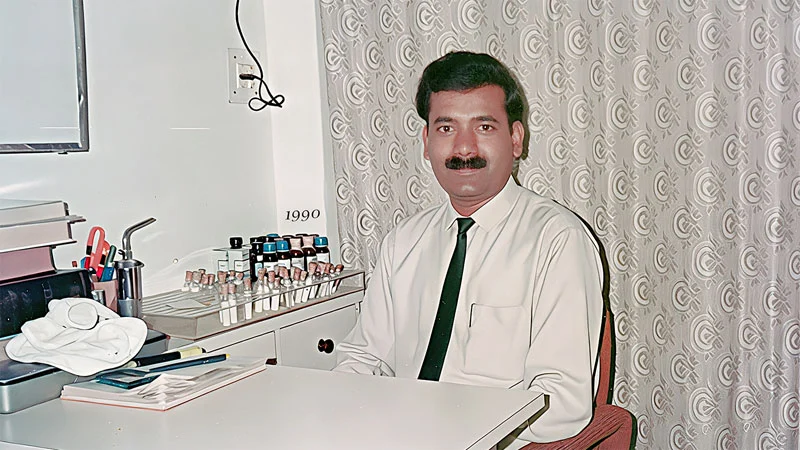
While sifting through a neglected pile of old files and folders in a quiet hour of the afternoon, I stumbled upon a photograph that time had quietly tucked away. It slipped out from between a fading seminar handout and an old appointment diary, landing softly on my lap — a square, curled print with the slightly dulled tones of an era long gone. As I turned it over, something shifted in me.
There I was — younger, leaner, perhaps even a little lost — seated behind a modest table, my first homeopathic clinic arranged carefully around me like a declaration no one else had noticed. The room was bare, the remedies neatly stacked, and no nameplate, no awards, etc.
And just like that, in that unguarded moment, decades dissolved and I was face-to-face with the man I used to be.
This wasn’t just any photo. It was the last frame of a 36-exposure roll — something the younger generation today may never fully understand. Back in 1990, taking a photograph was not a casual act. Film rolls were limited and costly; every click had to be worth it. There were no previews, no retakes. Once the roll was used up, it had to be taken to a D&P — developing and printing — studio, a process that took days and came with a price. This image, I remember now, wasn’t planned. It was spontaneous — a leftover frame someone decided to use, perhaps more out of affection than occasion. “Let’s take one here too.” Looking back, that one casual click had unknowingly captured the quiet courage of a beginning.
In 2025, a photo like this feels almost dreamlike. Today, we click dozens of images before breakfast and delete them with equal ease. But this one — singular, unedited, physical — carried a gravity that no digital image could match. It wasn’t just a snapshot. It was a stillness preserved, a moment that had waited for me patiently in silence. As I held it in my hand, I didn’t feel nostalgic in the usual sense. I felt reverent — as if this photo had always known it would return to me one day, not to remind me of how I looked, but to remind me of who I was becoming.
That small square of paper opened a doorway I didn’t know I had closed — a doorway not just to memories, but to meaning. In that image, I didn’t see the start of a clinic. I saw the start of a journey — one lined not with applause or assurance, but with patience, uncertainty, and an almost sacred silence. That one forgotten photograph became my mirror, my milestone, and my message — asking not what I had achieved in 35 years, but what I had become.
In 1990, just a year after completing my BHMS, I set up my first clinic in a small room with the kind of hopeful nervousness only a freshly graduated doctor can carry. It was not grand by any stretch—there was no reception desk, no waiting area, and certainly no digital presence because the word ‘digital’ had not yet entered our professional vocabulary. The furniture was minimal: a simple table, a couple of plastic chairs, and a small rack I had arranged with care, filled with remedies that looked more like a personal collection than a professional dispensary. A small board outside — not because I wanted it to be, but because budget constraints often determine aesthetics in the early days. Yet, even in its simplicity, that setup felt like something sacred. It wasn’t just a room; it was my declaration of commitment to this path I had chosen, or perhaps, that had chosen me.
There was no patient base to inherit, no mentor referring cases, and certainly no algorithms pushing my name into anyone’s feed. Every morning I would walk to that clinic with quiet determination, open the door, wipe the table, adjust the bottles, and sit down. And then I would wait. Some days, I would spend five, six, even seven hours in that chair with no patient walking in. The sound of the fan became my companion. I would read, revise, and write notes not out of enthusiasm, but to escape the hollow feeling of being forgotten by the world. That emptiness was not just about having no patients—it was about wondering whether anyone would ever come. Whether this degree, this effort, this space, would ever be enough to build something real.
Eventually, a few did come. Hesitantly, curiously, often as a last resort. A middle-aged man with acidity. A child with allergies. A woman with hair fall. They would walk in, look around as if surprised to see someone so young sitting behind the table, and ask questions not just about their illness, but about my identity. “Are you the doctor?” they’d say, almost puzzled. “This is for small illnesses only, right?” “How can these sweet pills do anything?” “Can you treat serious disease or just the common cold?” “Homeopathy takes time, doesn’t it?” I don’t remember how I answered them, but I do remember how those questions made me feel — small, doubtful, and yet strangely resolved. Because beneath the hesitation in their tone was a deeper question I was asking myself every day: Can I really do this?
But I showed up the next day. And the day after that. I kept opening the clinic, straightening the chair, and waiting — not just for patients, but for purpose. I didn’t realize it then, but those long hours of waiting were preparing me in ways no textbook ever could. They were teaching me presence. They were teaching me patience. They were teaching me the quiet strength it takes to sit still in the face of uncertainty — and that, perhaps, is where the real practice of homeopathy begins.
In those early years, the struggle wasn’t limited to building a practice; it extended deeply into confronting how the world viewed us. I often found myself comparing my path with that of my MBBS friends, who had secured seats in government medical colleges. Their lives seemed defined by clinical rounds, surgical observations, emergency calls, and visible validation. Society applauded their journeys. Parents boasted about them. Their white coats were not just uniforms—they were symbols of societal approval. Meanwhile, I sat in my modest clinic in the background of medical conversations, sometimes introduced awkwardly, sometimes not at all. There was always a shadow hanging over the word “homeopathy,” and I could feel it even in the silence that followed when I told someone what I practiced.
The 1990s were not kind to the credibility of homeopathy. It was still viewed by many as a fringe path—good for minor problems, not to be trusted in serious conditions. If someone was diagnosed with asthma or arthritis or PCOD, they sought allopathy first. If that failed, they came to us, not with confidence, but with cautious curiosity. And yet, we were expected to perform miracles. People wanted quick relief, and if we didn’t deliver it in the first consultation, they questioned the system, not their understanding of healing. “Homeopathy takes time,” they’d say with thinly disguised impatience, as though that were its greatest flaw. What they missed, of course, was that its slowness was deliberate—it wasn’t about delay, it was about depth.
I felt that social stigma personally. At family gatherings or social events, when someone said they were a doctor, all ears turned toward them. But when I said the same, followed by “homeopath,” the interest gently faded. Some would offer a polite nod, others a vague smile, and occasionally, someone would say, “But you’ll do MBBS later, right?” The assumption was always that this was a compromise, not a calling. And yet, I stayed. Not out of defiance, but because something in me felt quietly certain that healing didn’t always need to be loud to be real.
Financially, those years were fragile. The earnings were inconsistent, sometimes nonexistent. There were months when my expenses outweighed my income. Friends from other streams had moved into salaried jobs, while I was still investing time in people who might or might not return. But in the midst of that uncertainty, something was happening—I was learning to observe. I was listening more carefully, sitting longer with my patients, noticing patterns beyond what was said. I was developing clinical wisdom—not from cures, but from continuity. Each case became a conversation. Each conversation became a clue. Slowly, without ceremony, I was becoming the doctor I had imagined being—not through validation, but through presence.
Those years taught me that while the world admired speed, homeopathy demanded stillness. It didn’t rush to relieve—it sought to resolve. And perhaps that was its greatest strength: it believed that healing was not an intervention, but a process. And to serve that process, one had to stay—not just in the room, but in the deeper rhythm of the patient’s unfolding story.
The first fifteen years of my practice were not meteoric; they were quietly formative, like the slow growth of a tree whose roots go deeper before its branches rise. From the outside, it may have looked like nothing remarkable was happening. But inside that clinic, in the silent exchanges between symptoms and stories, between hesitation and healing, something foundational was being built. Patient by patient, hour by hour, I began to earn not just trust, but a deeper understanding of the homeopath I was becoming. There was no sudden surge, no dramatic breakthrough. What there was instead was continuity—returning patients, gradual referrals, families that began to see me not just as a doctor for one ailment but as a companion in their health journey.
As my practice grew gradually, so did my inner landscape. I began to notice a shift—from defending my profession to embodying it. The self-doubt that had haunted my early years didn’t disappear overnight, but it softened each time a patient returned with genuine relief in their voice. A chronic skin condition resolved after months of steady care. A child who once coughed through every winter now played outside with ease. A woman struggling with hormonal imbalance conceived naturally. These were not headlines, but they were milestones. And each one planted a new seed of self-belief.
But alongside this growth came a consistent stream of questions—some curious, some confrontational. “Where is the scientific proof?” people would ask, as though healing had to be validated in journals to be real. I learned to respond not with defensiveness, but with experience. I would gently say, “The proof is in the person who got better, whose suffering eased.” Others would say, “Isn’t it just placebo?”—a word tossed casually, often by those who had never sat through a proper case-taking or seen a remedy work in an unconscious child or a nonverbal patient. And of course, the old question lingered: “Why didn’t you do MBBS?” Sometimes it was asked kindly, other times as a covert criticism. But over time, I stopped trying to explain. My work had begun to answer for me.
There were also practical questions, rooted in doubt. “Can you treat serious diseases—like cancer or diabetes?” “Are you even allowed to prescribe in emergencies?” “Why are you charging so much for sugar pills?” I faced them all—not with textbooks in hand, but with steadiness. I would explain that I don’t treat cancer or diabetes as diseases—I treat individuals living with those conditions, and help them regain equilibrium. I would clarify that in emergencies, my job is to refer, not to replace life-saving intervention. And as for the sugar pills—I would simply say, “You’re not paying for the pills. You’re paying for the understanding that led to the right one.”
Those fifteen years didn’t just teach me medicine—they taught me grace under questioning. They helped me see that conviction isn’t loud; it’s consistent. And that belief, when born of practice, doesn’t need validation—it becomes its own proof. In that period, I didn’t just become a practitioner. I became a homeopath in spirit.
After spending years nurturing my practice in one small space, rooted in routine and relationships, life nudged me toward change. It wasn’t an ambition-driven shift, but a quiet inner readiness that told me it was time to shift—not by discarding what I had built, but by expanding it. So, in the mid-2000s, I made the decision to relocate my clinic to Gurgaon. It was a move that felt both daunting and necessary. I wasn’t starting from scratch, but I was stepping into a space where my name meant little, where the relationships I had built over a decade and a half would no longer follow me in person, and where the urban rhythm was faster, more skeptical, more transactional.
Gurgaon, even then, had begun its transformation—from dusty fields and sleepy lanes into rising towers, gated colonies, and digital ambition. The patient base was different—more informed, yes, but also more impatient. People came with reports already printed, second opinions already formed, and an urgency that didn’t always align with the slow, inward philosophy of homeopathy. I sensed a cultural resistance to the kind of listening I offered. “How long will this take?” was no longer a question—it was a challenge. Many came with conditions worsened by fast fixes, hoping for something different but expecting the same speed. It was a paradox I had to navigate carefully.
Re-establishing myself in this new environment wasn’t as much about infrastructure as it was about presence. I had carried with me fifteen years of clinical maturity, a deepened confidence in my method, and a way of seeing patients that wasn’t hurried or mechanical. I didn’t advertise. I didn’t create noise. I simply opened my doors and waited. One patient became two, two became ten, and slowly, once again, trust began to take root. But this time, it grew—not because the world had changed, but because I had. I no longer needed to prove who I was. I had lived through the doubt, and had emerged with clarity.
Every conversation I had in my Gurgaon clinic was different from those in my first practice, but the core remained unchanged. I still listened the same way. I still asked questions others skipped. I still sat with people in silence when needed. But this time, the room around me felt more prepared to hold that space. The desk was sturdier. The name board more polished. The confidence more embodied. I wasn’t trying to appear like a doctor anymore—I was one, in every sense of the word.
Relocating wasn’t about reinvention. It was about elevation. I wasn’t leaving behind the lessons of my first clinic—I was carrying them into a broader context. With each passing year in Gurgaon, I didn’t just re-establish my presence; I refined it. I became, slowly and steadily, not just a homeopath who had stayed—but a homeopath who had grown, adapted, and continued, without ever losing sight of the spirit that had started it all in that quiet room in 1989-90.
Over the last twenty-one years, a quiet constancy has defined my days. I have sat in the same chair, opened the same clinic door, welcomed patients from the same neighborhood and beyond, and practiced the same philosophy of care I began with. There has been no relocation, no reinvention, no marketing campaign or social media blitz. Yet the space has grown—not outwardly in square footage, but inwardly in depth, trust, and healing. In a world that celebrates movement, I chose stillness. And it is this stillness, this commitment to continuity, that has become the most powerful medicine I offer.
In these two decades, I have witnessed time flow not just through calendars but through people. I have treated young women who now bring in their teenage daughters. I have held the pulse of children who are now fathers, coming in with babies of their own. I have heard the same family surnames in three different generations, all sitting across from me with the same questions—but a deeper faith. There’s a rhythm to this that humbles me. In a transient world where nothing seems to last, the clinic has become an anchor, a thread that connects people to something beyond just symptom relief. It connects them to a sense of remembered care.
And what’s more moving is how they speak of it. “Doctor saab, you remember what I told you ten years ago,” someone said recently, after I referenced a minor detail from an old case that had remained in the back of my mind. Another smiled through tears and said, “Aap sunte ho — aur wahi kaafi hota hai.” These moments are not about pride. They are about confirmation—that presence, when genuine, leaves an imprint deeper than any prescription. That the act of listening, without rush, without interruption, is itself therapeutic. Over time, I’ve realized it’s not only about which remedy I select—it’s about how present I am when I select it.
Patients came, not because I reached out to them, but because someone they trusted had found help here. Word spread not in volume but in whispers, in quiet testimonials that crossed drawing rooms and dining tables. I didn’t follow trends. I didn’t package myself as a lifestyle expert or alternative guru. I stayed with what I knew best—being there. Consistently. Unpretentiously. And somehow, that became enough.
This long tenure in one place didn’t just help my practice grow—it allowed me to understand the community I served. I learned their rhythms, their hesitations, their family stories, their emotional undercurrents. It allowed me to treat not just individuals, but generations shaped by the same local air, the same social patterns, the same inherited anxieties. And in treating them, I too was shaped—into someone who no longer chased validation, because he had already lived the answer.
In the end, presence—pure, attentive, sustained—became my most enduring medicine. And it is this presence, above all else, that I continue to offer, every time the bell rings and another patient walks in with hope in their eyes and a story waiting to be heard.
Back in 2002, quietly and without much noise, I had prepared a manuscript—an academic contribution shaped by my growing conviction in clinical observation, honed through years of casework, late-night reading, and the steady rhythm of practice. It was not a grand thesis meant to change the world. It was simply the distilled essence of what I was experiencing as a homeopath, and the questions I was trying to answer—not with theory alone, but with real patients, real remedies, and real results. I worked on it between consultations, sometimes jotting thoughts on the back of prescriptions, sometimes typing deep into the night when the clinic fell silent. And then, life intervened.
Back in 2002, while pursuing my postgraduation in homeopathy, I quietly worked on my thesis—a manuscript born from careful observation, and long nights of reflection. It wasn’t written to change the world, but to explore the real questions I was facing. I shaped it between consultations, scribbled ideas on prescription backs, and typed into the silence of late nights. Then, as life unfolded, the manuscript was set aside.
As the years passed, priorities shifted. The manuscript—once alive on my desk—was shelved in a corner. Practice demanded attention. Family responsibilities grew. Patients came with urgent stories, and my days became about healing in the present, not publishing for the future. Somewhere along the way, I stopped asking, “When will this be published?” and instead leaned deeper into the work itself. The manuscript remained there, patiently waiting—not just for time, but for me to be ready.
Get your copy of Boger’s Legacy from Amazon now !
It took twenty-one years for that moment to arrive. When I finally returned to those pages, it was with a different gaze—not the enthusiasm of a young writer, but the quiet maturity of someone who had lived the content he once theorized. What I had written in 2002 now felt both fresh and seasoned. Some lines carried naïve certainty, others unexpected depth. But what moved me most was how it still resonated. It hadn’t aged poorly. It had, in fact, ripened. And that’s when I knew—it wasn’t late. It was right.
When the book was finally published, it was not to claim a milestone, but to close a circle. Recognition came, yes. Appreciation followed. But what touched me deeper was the internal sense of completion. Of having allowed something to bloom in its natural time, not rushed by ambition or external pressure. I realized that some works are not delayed—they are just destined to appear when the author has grown into their own words.
To younger homeopaths, especially those feeling the urgency to be seen, cited, or celebrated, I want to say this: your power lies not in being published, but in being present. In listening deeply. In staying with your patient even when the world is moving faster than your practice. There will be time to write. But don’t rush your voice. Let it mature. Let your insights ferment in silence. And when the time is right—not just for the world, but for you—your words will find their place.
In hindsight, the 21-year delay didn’t diminish the work. It sanctified it. It gave it weight. And perhaps, that is the hidden blessing of quiet effort—it may be invisible to the world for years, but when it emerges, it carries the strength of having waited.
Even after three and a half decades of practice, some questions still return—whispered by patients, challenged by skeptics, asked with concern by students, and sometimes, echoed in the silent corners of my own mind. They are not new. They are recurring visitors, arriving in different words but carrying the same essence. “Isn’t homeopathy just placebo?” “Do your medicines even contain molecules?” “Where is the scientific explanation for the vital force?” “Can you really treat serious illnesses?” “Why don’t more people accept it if it works?” “Why didn’t you choose MBBS instead?” “Is this struggle worth it?”
In the early years, these questions used to shake me. I would feel the need to answer sharply, defend deeply, explain passionately—sometimes more to reassure myself than to convince the other. But over time, practice becomes the strongest answer. And now, after thousands of prescriptions, countless follow-ups, and uncountable hours of listening, my responses have softened. I no longer feel the urge to convince. I speak now not from theory, but from lived truth.
Is it placebo? No, it’s not. I’ve seen infants respond, unconscious patients stabilize, animals recover—beings untouched by belief. But more than that, I’ve seen people transform—not only in symptoms, but in self. In their ability to breathe without fear, to sleep without nightmares, to walk without pain, to feel heard without judgment. And if all that is placebo, then maybe placebo deserves more respect than we give it.
Do these pills contain molecules? Often, no. But they contain meaning. They contain the distilled imprint of a substance, potentized through intention, repetition, and resonance. And while modern science may not yet fully grasp how water or lactose can carry information, healing does not wait for full explanation to occur. It just happens—in lives, in homes, in histories.
Why didn’t I choose another path? Because this one chose me. And I stayed. Through ridicule, through skepticism, through lonely days and modest months, I stayed. Not out of stubbornness, but out of trust. Because I had seen too much healing to walk away from it, just because someone else hadn’t.
Yes, we don’t always succeed. We refer when we must. We err sometimes, like any profession. But what we never do is abandon the idea that the body, mind, and spirit are connected—that healing is not only possible, but personal.
And yes, the questions about education, regulation, and public trust still linger. We do need better systems, stronger peer review, deeper scientific dialogue, and more collaborative openness. But we also need to preserve the soul of this art: the patient sitting across, the story unfolding, the remedy chosen not from protocol, but from presence.
So no, homeopathy may not roar. It may not fill emergency rooms or dominate headlines. But in quiet rooms across the world, it heals. Slowly. Deeply. Lastingly. And perhaps, in a world rushing toward instant answers, this slow certainty is its greatest power.
Looking back now, not just at the photo from 1990 but at the long, winding road that followed, I realize that some of the most profound lessons in healing were never taught in textbooks or classrooms. They emerged slowly, across years, across seasons, across the countless times I opened the same door, sat on the same chair, and said, “Please, tell me everything.” In those three-and-a-half decades, what I built was not just a practice—it was a rhythm, a presence, a life aligned with purpose. And what that life taught me is not about formulas or fame, but about staying.
You don’t build trust in five years. Not in this field. Not in this world. Trust is not a business model; it’s a slow harvest. It grows only when people see you still there—year after year, monsoon to summer to winter, through their joys and losses, when they know they can return and find you unchanged. The same chair. The same table. The same listening. That quiet continuity becomes a kind of healing itself. In a world that keeps shifting, your stillness becomes sanctuary.
You also learn, with time, that you don’t need to prove yourself. You need only to be yourself—and to be there. I no longer answer every accusation. I don’t explain homeopathy in scientific terms to every skeptic. Instead, I remain available. I listen. I prescribe. I watch healing unfold, not always dramatically, but often decisively. And when someone leaves lighter, breathing easier, feeling seen—that is all the proof I need.
I’ve also come to see that the miracle rarely lies in the medicine alone. The medicine matters, yes. The repertory, the rubrics, the materia medica—they are my instruments. But the transformation happens in the relationship. In the space where someone feels safe enough to unravel. Where they speak of pain others dismissed. Where their story is not shortened to suit a prescription pad. That trust, that safety—it shapes the remedy. It sharpens intuition. It turns the act of healing into something sacred.
Branding, I’ve learned, is transient. Continuity is eternal. I never advertised. I never rebranded myself as a lifestyle healer, a modern guru, or a “wellness expert.” I simply stayed. And that act—of remaining rooted, of showing up every day for years—did more for my reputation than any campaign ever could. People remember presence. They remember who remained when others moved.
Most of all, I’ve learned that staying is not stagnation. It is strength. It’s easy to chase novelty. It’s harder to cultivate depth. But it is in that depth—in those hundreds of quiet conversations, in the long pauses, in the remembered cases—that wisdom takes root. And over time, your chair is no longer just a seat in a clinic. It becomes a place of meaning. A place of witnessing. A place from which lives are seen, heard, and healed.
Thirty-five years later, I remain seated. Not because I had nowhere else to go. But because this chair taught me everything I needed to know.
To the young homeopath reading this—maybe sitting alone in a small room with a stethoscope, a glass rack, a few books, and long stretches of silence between patients—know this: you are not alone. I’ve sat in that same silence. I’ve looked at the empty chair across my desk and wondered if the world would ever find its way to my door. I’ve questioned whether my art would survive in an age that prizes immediacy, machines, and measurable miracles. But with time, I’ve learned something invaluable: even when the world doesn’t see you, your work sees you.
Your clinic may not be large. It may not have fancy interiors, waiting rooms, or electronic panels flashing your name. But what it does have—if you allow it—is your presence. And that is something no one else can replicate. Your way of seeing, listening, interpreting—not through gadgets, but through attention—is rare, and deeply needed. You may not have a CT scanner or a lab in your chamber, but you have something subtler: perception, cultivated over time. The ability to hear what is not said, to notice what others miss, to read the pulse of a person beyond numbers and graphs.
There will be days when you feel invisible. Days when friends in other fields seem to be progressing faster. Days when your inbox is quiet and your income uncertain. You’ll be asked—sometimes kindly, sometimes mockingly—“Why homeopathy?” You may be tempted to justify, to defend, to prove yourself. But you don’t need to. Let your results speak, quietly but consistently. Let your presence be your answer. Don’t give up because others don’t understand. Healing has always been misunderstood before it is celebrated.
Build your practice not like a startup, but like a tree. Let your roots go deep. Let your foundation be slow, silent, and unseen. Water it daily—with reading, reflection, and patience. Don’t measure your worth by the number of cases you see in a day, but by the depth of connection you create with each one. Remember, even a single well-managed chronic case teaches you more than any seminar or certificate ever could.
You may not go viral. Your success may not be loud. There may be no awards, no trending posts, no applause. But one day, a patient will walk in and say, “Doctor saab, I don’t know what you gave me, but I feel like myself again.” And that moment—that quiet, unmarketable moment—is your real reward. It is vital, not viral. It is what sustains you.
So stay. Stay with your method. Stay with your intention. Stay with your patients. Because this world needs more people who don’t just cure symptoms, but witness suffering—and respond, not with ego or urgency, but with understanding. And that, dear young homeopath, is the rarest form of medicine there is.
I return, one last time, to that photo from 1990—the black-and-white window into a moment that might have seemed ordinary then, but now glows with quiet significance. It shows a young man, just past medical school, seated behind a plain table. No clinic branding, no digital screen, no award on the wall. Just a few homeopathic bottles arranged carefully, some files, a sense of formality in his posture, and something even more telling in his eyes—hope, tempered with uncertainty. At that time, I didn’t know this photo would one day become a mirror, reflecting not just what I looked like, but who I was becoming.
It did not capture someone who had arrived. It captured someone who had begun—tentatively, with minimal resources but maximum faith. I see now how little I knew, how limited my means were, how raw my confidence felt. And yet, I also see what mattered more: I had chosen to stay. I had chosen not to abandon this path when the world made it easier to walk away. That first clinic wasn’t just a small space—it was a commitment, quietly made, to a vocation that demanded patience more than prestige.
Over the years, many things have changed. The racks have become more organized, the prescriptions more precise, the face older, the understanding deeper. But that chair in the photo—that place where I first began listening—remains unchanged in spirit. I’ve sat in many chairs since then, in different rooms, but none carried the emotional weight of that first one. Because that was the chair of choosing—of choosing homeopathy, of choosing humility, of choosing to be available when there was no guarantee of success.
And so today, thirty-five years later, I’ve decided to frame that photo. Not for the wall of accolades. Not for any clinic display. But for myself. For the quiet reminder that life is not built in sudden breakthroughs, but in daily decisions to stay with what you believe. That image is not just of a young homeopath—it is of a beginning that knew its strength only in hindsight. A beginning that led to a life not of glamour, but of groundedness.
When I look at it now, I do not feel pride as much as I feel gratitude. Gratitude that I had the courage to begin, the resilience to continue, and the grace to remain true. That photo is not about arrival—it is about intention. And intention, as I’ve come to learn, is everything.
So I frame that photo not to show off where I started, but to remember why I stayed. And whenever someone asks me what it takes to build a meaningful practice, I might just point to it and say, “This is where I first chose to stay. And that made all the difference.”
And I stayed.
Truly mesmerizing journey, many patients shaped and crafted us by helping us to be what we are…
Thank you so much, Prof. Dr. Siraj Sir. Indeed, every patient has been a silent teacher, refining our perception and deepening our purpose.
Grateful for your kind words.
Dr. Anil Singhal
As a young Homoeopath, reading this blog truly moved me. It beautifully reminded me how important it is to be present—not just physically in a clinic, but emotionally and mentally with each patient, every day.
Your storytelling is so honest and relatable, it made me reflect on my own beginnings and gave me a deeper sense of purpose. Thank you for sharing this piece—your words really stayed with me.
Grateful for such heartfelt writing!
Thank you so much, Dr. Shubhanshi. Your words truly touched me. It’s heartening to know that the piece resonated with your own journey. Staying present—emotionally and mentally—is indeed the quiet art we continue to learn with each patient. Wishing you strength, clarity, and fulfillment as you shape your own path in homeopathy.
Dr. Anil Singhal