
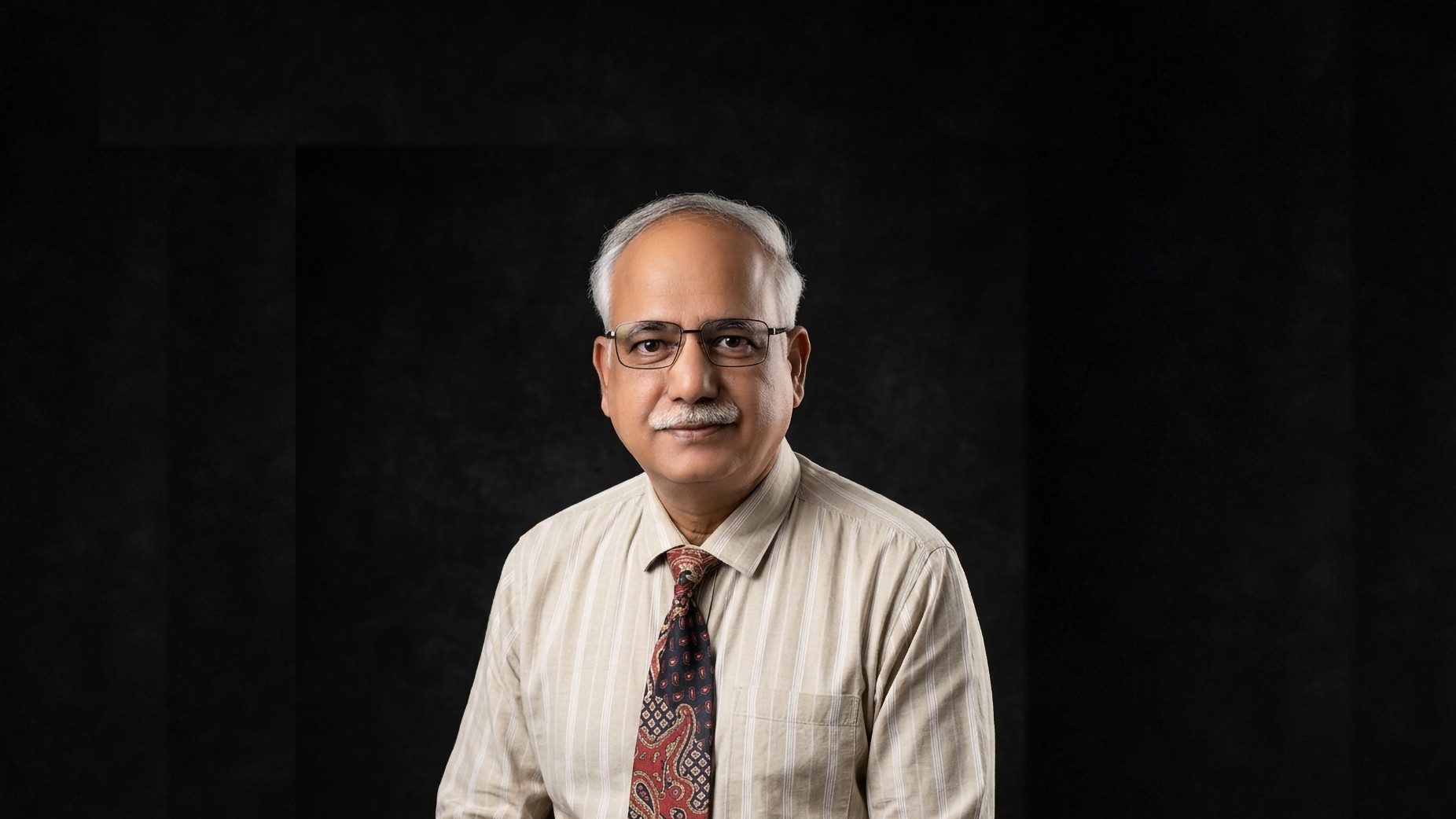
On 10 April 2026, I went to Vigyan Bhawan, New Delhi, to attend the conference held on the occasion of World Homeopathy Day in celebration of the birth anniversary of Dr. Samuel Hahnemann. Such gatherings always carry a special feeling for me. They are not merely professional events. They are occasions where memory, vocation, history, and fellowship come together. One meets old colleagues, sees younger generations of homeopathic doctors, hears familiar names, and feels once again that one belongs to a long and living tradition.
While passing through one of the corridors, I was greeted by a young homeopathic doctor with a respectful, “Good morning, Sir.” I acknowledged her warmly. Then she said something that touched me at once: “Sir, I am your student from NHMC, Delhi.”
Whenever I hear such words, something within me lights up. To meet one’s students after twenty years, twenty-five years, or even more, is a joy that is difficult to describe fully.
Time passes silently.
Students move ahead in life, establish themselves, become doctors, teachers, parents, and responsible members of society. We teachers, too, continue with our work, carrying countless classes, faces, lectures, and moments within us.
Much is forgotten in the ordinary flow of life.
Yet when a former student suddenly appears and identifies herself with affection and respect, a bridge is built in an instant between past and present. One feels both humbled and delighted.
As we spoke, she reminded me of an incident that I had almost completely forgotten. She said that when she was in the third year of BHMS at Nehru Homoeopathic Medical College, somewhere around 2008, she had received from me a volume of Harrison’s Internal Medicine. The moment she said this, time seemed to pause. In a few seconds, an entire scene from nearly eighteen years ago began to return to my mind.
I remembered that during that period I was taking some classes for the third-year students at NHMC on aspects of homeopathic philosophy. I have always believed that teaching should not be limited to routine dictation or examination-oriented instruction. A class should awaken thought. It should make students engage inwardly with ideas. On one occasion, I had given the students an assignment on a topic and asked them to write it out and submit it in the next class.
Many students completed the work sincerely and handed in their assignments. I took those notebooks and papers back with me and, as was often my habit, read them later during the free intervals of my clinic hours. Reading students’ written work in solitude has its own pleasure. It reveals not only who has studied, but who has thought. It shows effort, seriousness, originality, and sometimes even the early signs of intellectual character.
Among all those assignments, I noticed that two were exceptionally good. They stood apart. There was clarity in them, seriousness, and a certain care that made me feel these students deserved to be encouraged in some special way. I still remember the feeling, though not the exact words written in those papers. Good work by a student naturally gives joy to a teacher. It suggests possibility. It tells you that the mind before you is awake.
On the day of my next class, as I was preparing to leave for NHMC with those checked and marked assignments, a thought came to me quite naturally: I should give some books from my own collection to the two students whose work had impressed me. There was no grand planning in this. It was simply an impulse of affection and appreciation. I turned to my bookshelves and my eyes fell upon two volumes of Harrison’s Internal Medicine. I immediately picked them up and carried them with me to the college.
I had thought that as these students would soon enter the fourth year, where they would have “Practice of Medicine” as a major subject, Harrison’s could serve as a useful reference work for them. When I entered the class and began returning the assignments, I called those two students and presented one volume to each of them. I also remember telling them that they could exchange the two volumes with one another, so that both could benefit from the complete work.
At that time, I did not think of this as an event that would be remembered after so many years. For me, it was a simple gesture. A teacher had seen merit in the work of two students and wanted to support them in a practical way. That was all. But life has its own ways of preserving moments that we ourselves do not preserve.
As she stood before me in the corridor at Vigyan Bhawan and recalled that incident, I felt deeply moved. In those couple of minutes, much more than a memory returned. An entire phase of life returned. The classrooms of NHMC came back. The atmosphere of those years came back. The seriousness of teaching, the trust of students, the simplicity of academic life in those days, all came back with unusual freshness.
It also brought back another stream of memory related to my lifelong love for books. Since childhood, I had the habit of collecting books. Books attracted me not only as objects of study but as companions. Over the years, I gathered books from many places – Daryaganj, old bookshops, libraries, and wherever I could find worthwhile volumes. In homeopathy especially, from around 1984 onward, I collected and purchased books with great interest. Slowly, over years and decades, a personal archive took shape around me.
Books were never, for me, decorative possessions. They were sources of knowledge, silent teachers, and carriers of accumulated wisdom. Yet as life advances, one begins to see one’s own collection differently. After crossing forty-two or forty-four years of age, a thought gradually formed in my mind: perhaps I would not be able to read all these books again in my lifetime. Many of them had remained untouched on the shelves for years. Some had not been opened for a very long time, and quite possibly would never be opened again. At that stage I felt that knowledge should not remain imprisoned in private cupboards. Books should circulate. Wisdom should travel forward. I never wanted merely to hoard such treasures.
It was with this feeling that, over the years, I began giving books from my collection to deserving students. This became a quiet habit with me. If I found seriousness, sincerity, and promise in a student, and if I felt that a particular book could nourish that student’s growth, I felt happy in parting with it. There was no sense of loss in such giving. On the contrary, there was relief and satisfaction. A book lying silent on my shelf might perhaps awaken thought in another life.
After giving books, I never made a record of who received what. I never thought in terms of remembrance or return. In those days, mobile phones did not have cameras as they do now. We did not photograph every small event for future proof. Much of life was entrusted simply to memory. And memory, by its nature, keeps some things and lets many others dissolve.
That is why such renewed encounters with former students affect me deeply. They are heart-touching not merely because someone remembers me, but because they show that a small and sincere act done in the natural flow of life may continue to live quietly in another heart. What I had forgotten, she had remembered. What for me was one among many acts of encouragement had, for her, evidently remained a distinct memory even after eighteen years. This realization has its own sweetness. It tells a teacher that nothing given in the right spirit is ever truly lost.
In our profession, we often speak of medicines, doctrines, institutions, and achievements. But there is another inheritance also, more subtle and more human. It passes from teacher to student through encouragement, trust, example, affection, and timely recognition. A good word, a thoughtful gesture, a book placed in the hands of a young student at the right moment – these too become part of education. They may not enter official records, but they remain inscribed somewhere in the inward history of a life.
As I stood there in the corridor of Vigyan Bhawan, speaking with this former student about an incident from 2008, I felt a quiet happiness that is difficult to express in plain language. It was as if time had folded upon itself. The teacher of those days and the person I am today met each other in that brief conversation. Such moments are mesmerizing because they remind us that life does not move only forward. At times, it turns back gently and offers us one forgotten flower from our own past.
I came away from that meeting with gratitude in my heart. Gratitude for my students, who remember with such warmth. Gratitude for the years I was able to teach. Gratitude for the books that served not only me but others. And gratitude for the strange and tender ways in which memory returns to reassure us that no sincere act of giving is wasted.
Whenever I meet my students after many years, I feel this same inner tenderness. I see before me not merely individuals, but the continuing journey of life itself. I silently bless them and wish them progress, dignity, and fulfillment in all that they do. If, in some small way, my words, my classes, or even a book once given from my shelf have accompanied them in their journey, I feel amply rewarded.
Perhaps that is one of the quiet privileges of being a teacher.
Long after a class is over, long after a lesson is forgotten, and long after one has ceased to expect anything from the past, a student appears unexpectedly and returns to you a fragment of your own life, preserved with care.
And in that moment, one realizes that what was given in simplicity was received as grace.
U have narrated an excellent experience. Thanks a lot for sharing.
Namaste Sir,
Thank you very much for your kind words and encouragement.
It was indeed a deeply touching experience for me, and I felt happy to share this cherished memory.
Such moments remind us how beautifully the teacher-student bond continues to live across time.
Warmest regards,
Dr. Anil Singhal