
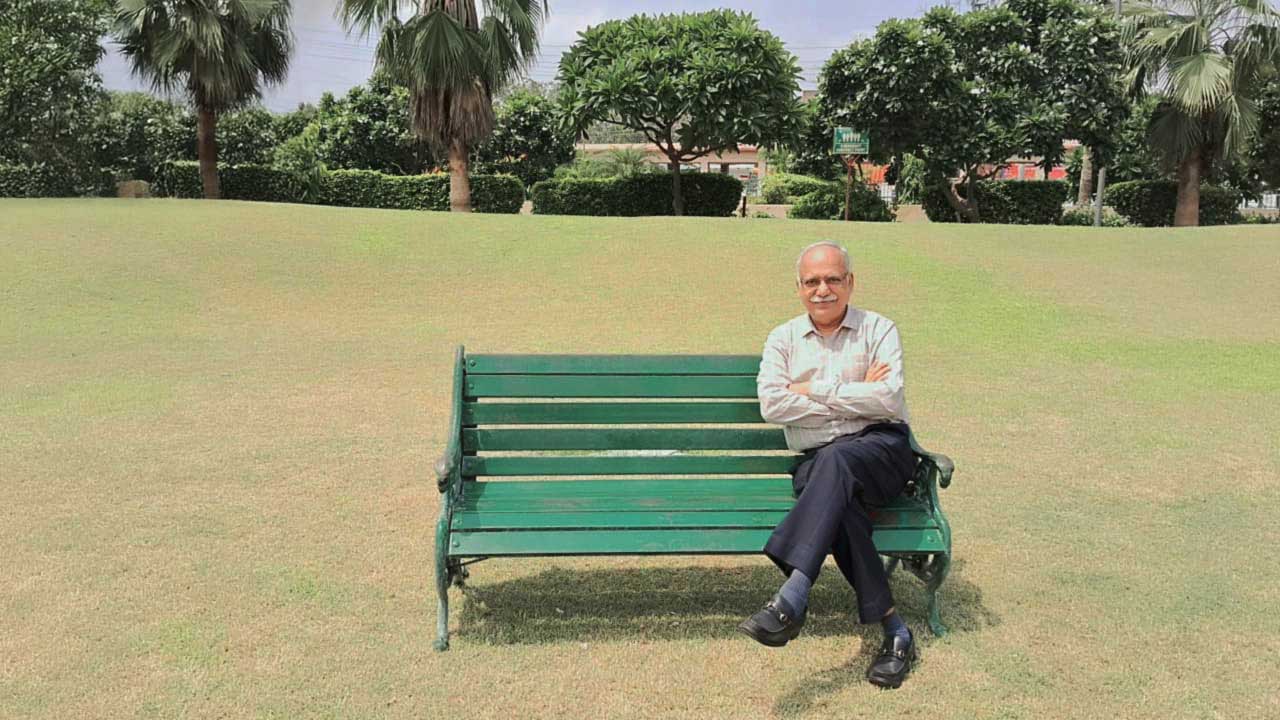
That afternoon, when the clinic finally fell quiet and the sun slipped a little toward evening, I sat with a cup of tea and felt time gather around me like an old shawl.
A small realization rose – gentle, certain, and a little urgent: my generation, my peers and I, are a bridge. We stand with one foot on stories whispered to us by our parents and grandparents, and the other on a road racing forward under the weight of inventions we once could not imagine.
Between these two shores – memory and momentum – we have lived, learned, and loved.
Our elders were born in British India.
Their childhoods smelled of ink and chalk, ration cards and railways, monsoon puddles and barefoot games.
They saw a nation cut and stitched, watched a tricolour climb into the sky, and learned how to build a life in the uneasy quiet after fireworks, speeches, and promises.
They grew up with very little and learned to make that “little” stretch into enough: enough health, enough education, enough hope.
They measured progress in lamps that lasted longer, roofs that leaked less, and journeys that could finally be made without fear.
When they told us their stories – partition, train platforms, the first Independence Day they saw – we felt the safety of being children inside a house of resolve.
They were our first history lessons, spoken without footnotes, delivered with a tremor in the voice that no textbook could carry.
And then, it was our turn to arrive – children of the sixties and seventies – into a world of radio melodies and newsprint smudges on our fingers.
Our cinemas were black-and-white to begin with, small screens in large halls, and then – almost magically – the screens bloomed wide.
Colour arrived as if someone had opened a window in the wall.
Sound began to travel around us: sometimes from the left, sometimes from behind, sometimes sweeping across the hall like a gust of wind.
We timed our weeks by the radio programs and learned our first sense of “schedule” from newspaper columns.
We measured our pocket money in movie tickets and samosas.
Television tiptoed in, not loudly, but with a single channel that woke up in the evening and folded itself to sleep at night.
A set in the mohalla felt like a landmark; neighbours carried stools across courtyards to watch together.
The streets echoed with games at dusk – gulli-danda, vish-amrit, kabaddi, kho-kho, chaupar, pitthu-garam.
Our grandparents told us stories after dinner; their voices were our night lamps.
And, in 90s, on some afternoons, we saw bank employees on strike in Delhi, protesting the arrival of computers, as if machines were a storm menacing the old order.
Pagers blinked their small messages in the nineties.
Personal computers entered timidly, humming with 640 KB RAM and hard disks measured in megabytes.
We learned the grammar of DOS commands and the patience of floppy disks.
Then came 1995 – a hinge in time – when a new window truly opened: Windows 95, the internet, and a new tone that sang from our phone lines as modems connected.
We remember that sound even now, like the first cry of a newborn era.
Soon, internet cafés glowed blue in narrow lanes.
Email addresses were traded like visiting cards.
The dot-com wave swelled; search engines multiplied – Yahoo, AltaVista – until one day “Google” became both a noun and a verb.
We learned to ask the world questions and get answers back in the time it took tea to cool.
Mobile phones moved from briefcases to shirt pockets.
SMS changed the way we made plans.
“Call me after nine” became a little household economics because the tariffs were lower at night.
Digital cameras replaced rolls of film; suddenly we could take another shot, and another, until the moment felt safely captured.
In clinics like mine, registers began to share space with spreadsheets.
Patients messaged for appointments, sent photos of prescriptions, and later, without ceremony, payments began travelling invisibly between two small rectangles of glass.
What used to be an afternoon errand became a tap, a ping, a done.
We watched the 2000s unspool into things our childhood never promised – broadband, online maps, satellite images of the same streets we used to cross for ice cream, and then, phones that were more than phones.
Music moved inside our pockets; so did books, tickets, and classrooms.
Our children learned to pinch and zoom before they learned to tie their shoelaces neatly.
Behind clinic doors, I saw medicine reinvent its corridors: research preprints moved faster, medical communities formed overnight across continents, consultations found their way to screens when illness kept people at home.
We discovered that care could travel through a camera and a voice when it had to.
And then the 2010s and beyond pushed the accelerator further – 4G, streaming, cloud drives, video calls that stitched families across oceans, and apps that shrank cities.
Taxis no longer needed waving hands; groceries found our doorsteps; exams appeared in browsers; libraries moved into search bars.
In the background, a quiet revolution kept learning from us: algorithms recommending what to watch, read, and listen to; maps predicting our paths; keyboards guessing our next word.
Somewhere along the way, “let me check” stopped meaning “I’ll ask someone” and began to mean “I’ll ask the world.”
Today, in 2025, we find ourselves mid-span on that bridge.
Our front line – the storytellers who held our hands through the older world – is thinning.
Their voices are softer; some have already stepped off the edge of the visible.
They left us with heirlooms that cash cannot measure: lullabies, habits, idioms, recipes, rituals of kindness, ways to say sorry without drama and to forgive without announcements.
They taught us the art of repairing: slippers, friendships, and chances.
Behind us, another line is forming – children of the twenty-first century for whom “buffering” is a rare annoyance and “dial-up” is a historical curiosity.
They have not run barefoot after a rolling tyre on a quiet lane.
They have not counted down to a weekly program like a festival.
They did not learn to calculate half and quarter in a notebook with a wooden pencil shaved on a matchbox; their first answers appeared on screens that glowed.
Their dictionary corrects them in real time; their grammar gets underlined by an algorithm that neither scolds nor smiles.
What they have, we never did: a sky so wide that asking a question is no longer an act of courage but a reflex.
What we have, they may not: the smell of rain on playground mud, the long patience of waiting for something you truly want, the humility of knowing that not everything can be fetched with a click.
Both are valuable. Both are needed. The bridge needs stones from both sides.
When I think of our cohort – doctors, teachers, engineers, shopkeepers, clerks, parents, friends – I see a generation fluent in two dialects: the old and the new.
We can read our grandparents’ handwriting and our children’s emojis.
We remember the first time a computer cursor blinked like a heartbeat in a dark room, and we also know the soft comfort of an AI assistant answering at 2 a.m.
We are citizens of the slow lane who learned to merge into the fast lane without forgetting how to look in the rearview mirror.
This is why I feel a responsibility that is as personal as it is public.
It is not enough to say “things were different.” We must tell how they were different, where we were standing when the difference touched us, and what changed in us because of it.
We must write the texture: the names of our street games, the sound of cricket commentary on the radio, the first email address we typed, the bank strike placards against computers, the thrill of a colour film that made us lean forward in our seats.
We must speak of the unease we felt when machines arrived, and the relief we felt when those machines made it possible to talk to a friend across the sea in a second.
We must tell our children how we learned to balance awe with caution, speed with care, and access with attention.
If we do not, a certain tenderness will vanish – the tenderness of slowness, of limited choices, of gathering with neighbours to share a single screen.
The tenderness of saving up to buy one good thing and loving it for a very long time.
The tenderness of letters that travelled days before they knocked on our doors, of apologies that needed a walk to deliver, of gratitude that came wrapped in a box of sweets rather than a text bubble.
These are not better times or worse – only different. But they are ours, and keeping them alive is another way of keeping our elders’ hands warm inside ours.
So, here is my small promise and invitation. I will write what I have seen and what I have felt – not as a historian, not as a technologist, but as a human being standing on this bridge, feeling the wind from both directions.
I will write for the child who cannot imagine a world without instant answers, and for the elder who cannot imagine why anyone would talk to a screen.
I will write for the patient who still prefers a doctor’s handwriting on a prescription, and for the student who prefers a PDF.
I will write because memory is medicine: it steadies the heartbeat of a home, a family, a community.
And I ask you – whoever you are, wherever you are reading – to place your own stone on this bridge.
Tell me the games you played at dusk.
Tell me about the first movie that made you forget your seat.
Tell me the sound of your home at dinner time before smartphones took their place at the table.
Tell me the first email that surprised you, the first time you searched for something and the world answered back.
Tell me how your parents measured “enough,” and how you are measuring it now.
We are a bridge – temporary but necessary, humble but strong.
Before the river rises again and the sky changes its colours, let us pass across what we have lived through: the tenderness and the turbulence, the repairs and the leaps, the patience and the speed.
Let us make sure the next generation can feel, not just hear, the world we crossed.
And as they run ahead with intelligence – artificial and otherwise – let them also carry a small, steady lamp lit by our stories.