
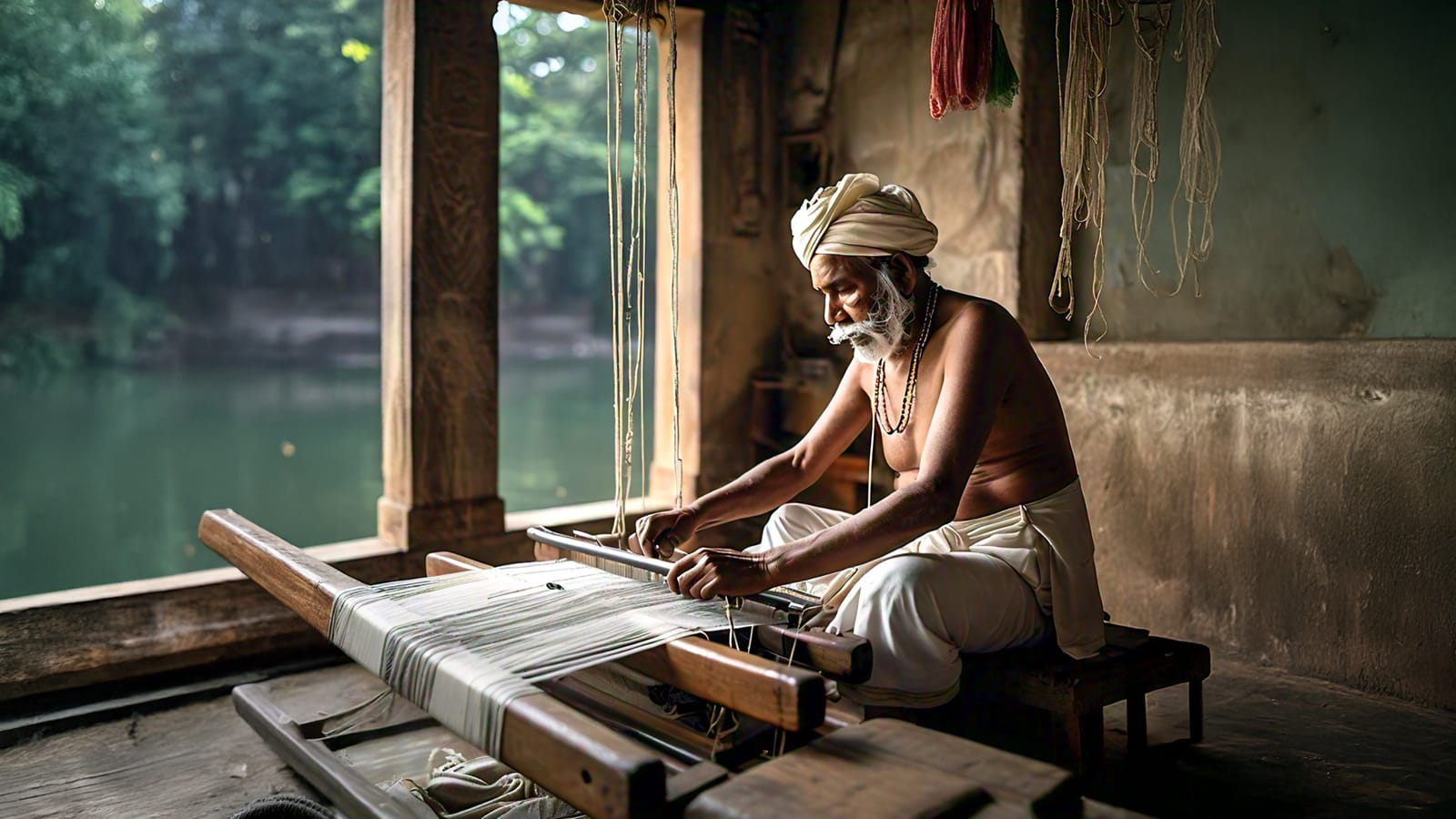
Once, in a small village by the river, there lived a humble weaver known for his simple lifestyle and wise words. He spent his days at the loom, weaving cloth for the townsfolk. People noticed that his work was more than just skillful—it had a beauty that seemed to reflect something deeper, something beyond the threads.
This weaver was not wealthy. He lived in a modest hut with few possessions, but he was known across the village for his calm and content behavior. People would often see him smile to himself as he worked, a quiet joy evident in his expression. For him, each day was a chance to create, to express, and to bring warmth to others’ lives through his cloth. Day after day, he would sit at his loom, his hands moving rhythmically, as if each thread had a purpose and each knot a hidden meaning. While others hurried to finish their work, he took his time, always saying that true beauty could only be woven with patience and care.
But life was not always easy for him. As he wove cloth, he also had to face the knots of poverty, criticism, and rejection. Some in the village looked down upon him because of his humble profession, viewing him as a man of simple means and lesser worth. Others criticized his words, finding his perspectives unusual or strange. But no matter the challenge, he continued to weave—not only cloth but also the fabric of his own thoughts and beliefs, remaining untroubled by others’ opinions. The weaver believed that just as each cloth had its own design, each life had its own purpose, unfolding in its own time.
Though he was gentle and patient, the weaver carried a question deep in his heart: What was the true nature of the soul? Despite his serene and contented exterior, he felt a lingering curiosity gnawing within. He had observed how people around him were often quick to judge one another, finding faults and comparing themselves, yet never seeming to find satisfaction. He wondered why people clung so strongly to illusions of wealth and status, why they missed the essence of life that lay beneath these distractions. He observed all of this with a quiet curiosity but often wondered, Was this all there was to life? The mystery of existence tugged at him as he wove, becoming an unspoken part of the fabric he crafted each day.
One day, after many years of working at his loom, he found himself at a crossroads. He realized that he had been weaving cloth all his life, but he wanted to weave something greater—an understanding of truth. It seemed that his hands had created enough cloth to last a lifetime, but his heart was still empty, still searching. He decided to set aside his loom and venture out, hoping to find answers. Perhaps a guru or a wise soul might guide him toward enlightenment, he thought. He left his village, carrying with him only a small bundle of clothes and the questions that had become too heavy to bear in silence.
As he wandered, he met sages, scholars, and holy men, hoping they might reveal the secrets of life. But none of their teachings satisfied him. Some spoke of rituals, others of sacrifices, some of renunciation, and others of rigid doctrines, but none seemed to touch the heart of the question that burned within him. He was seeking a truth that could be felt, not simply explained, and as he listened to their words, he found himself only more distant from the understanding he sought.
Disillusioned, he returned to his village, feeling as though he had been searching in the wrong place all along. Perhaps the answers did not lie in distant lands or in the words of others. Perhaps they lay somewhere closer, somewhere deeper. One quiet evening, as the sun dipped below the horizon, he returned to his loom, the familiar rhythm of his hands moving over the threads bringing him peace. Sitting by his loom in the dim light, he began to reflect on his life. He thought about the countless threads he had woven over the years, each thread separate yet all coming together to create something whole. Could life be like this cloth? he wondered. Each experience a thread, each emotion a knot—together, creating the full tapestry of who we are?
With a deep breath, he closed his eyes and turned his gaze inward. He began to see that his mind, much like his loom, was both the creator of beautiful patterns and the source of tangled knots. It became clear to him that just as his hands had carefully woven each piece of cloth, his mind had woven each thought, each memory, each hope and fear, into the fabric of his being. And he realized that he had been quick to find faults in others at times, just as others had judged him, and that his own pride had sometimes clouded his vision. He saw himself as both weaver and cloth, as both the creator and the creation of his life’s work.
In that quiet moment of self-reflection, he understood a profound truth: that true knowledge begins within. The answers he had sought in the words of others were, in fact, woven into his own soul, hidden within the folds of his own experiences. His mind was the loom on which his life was woven, and only by reflecting on it could he see the true fabric of his soul.
And so, the weaver returned to his work, but this time, he wove with a different understanding. Each thread he handled now carried the weight of wisdom, each knot tied with patience and humility. He realized that life’s purpose was not to escape its challenges but to find meaning within them, to weave one’s own path through self-awareness. Through this reflection, he found peace—not in the world around him, but in the world within.
As the years passed, his cloths became prized not only for their quality but for the presence of something inexplicable, a quiet energy that seemed to flow from the threads. People would say his work felt alive, almost as if it carried a hidden message. And perhaps it did, for each cloth bore the story of a weaver who had found his truth, not in far-off lands or grand teachings, but within the delicate threads of his own reflection.
In his journey, the weaver had learned that the beauty of life is not in the destination but in the weaving itself, in the patience with which we accept each thread and knot, each joy and sorrow. This wisdom he left to his village, a legacy woven in humility, understanding, and peace. His life became his message, and those who looked closely at his cloths would often say they felt the quiet strength of a soul that had found its way.
As the weaver came to understand, true insight arises from within, from examining the threads of one’s own thoughts and experiences. His journey revealed that the mind is both the artist and the canvas of life, shaping our perceptions, beliefs, and even our missteps. In the quiet of his reflections, he saw that wisdom and truth, like the fabric he wove, are intricately crafted within.
It is fitting, then, to end this tale with the words of Kabir, the mystic poet, whose doha captures this profound realization:
मन ही कागद कलम है, मन ही लेखा जान।
मन ही सांचा, मन ही झूठा, मन ही परे गुमान।।
The mind itself is paper and pen, and the mind knows the accounts;
The mind is the truth, the mind is falsehood, and it is the mind that holds pride.
Through Kabir’s timeless words, we are reminded that our lives are written by the hand of our own thoughts, intentions, and reflections. The journey of self-discovery, like the weaver’s, begins and ends within.
Hi Dr. Singhal
I read your posts here, and am enjoying your narratives. I believe main character of the story in preface is you.
All best to you.
Dear Sumit,
Thank you for your kind words and for taking the time to read The Loom of the Mind. You’re right—the weaver’s journey is, in many ways, my own. The cloth he weaves is stitched with my reflections, questions, and quiet search for meaning. I’m grateful you sensed that.
Your encouragement means a lot as I continue to share these threads from the inner loom.
Warm regards,
Dr. Anil Singhal
Hello sir
I read your posts regularly.
I enjoy all your posts. Easy narrative.
God bless you sir
Mrs. Tasneem Ezzi,
Thank you so much for your kind words and for regularly reading my posts. I’m truly glad to know that you find the narrative easy and enjoyable.
Your blessings mean a lot. May you be blessed with health and happiness always.
Warm regards,
Dr. Anil Singhal