
When I look back at my childhood, I do not first remember toys or birthdays. I remember paper. I remember the smell of old pages warmed by summer, the roughness of cheap print, and the quiet excitement of carrying stories home as if I had carried a small world in my hands.
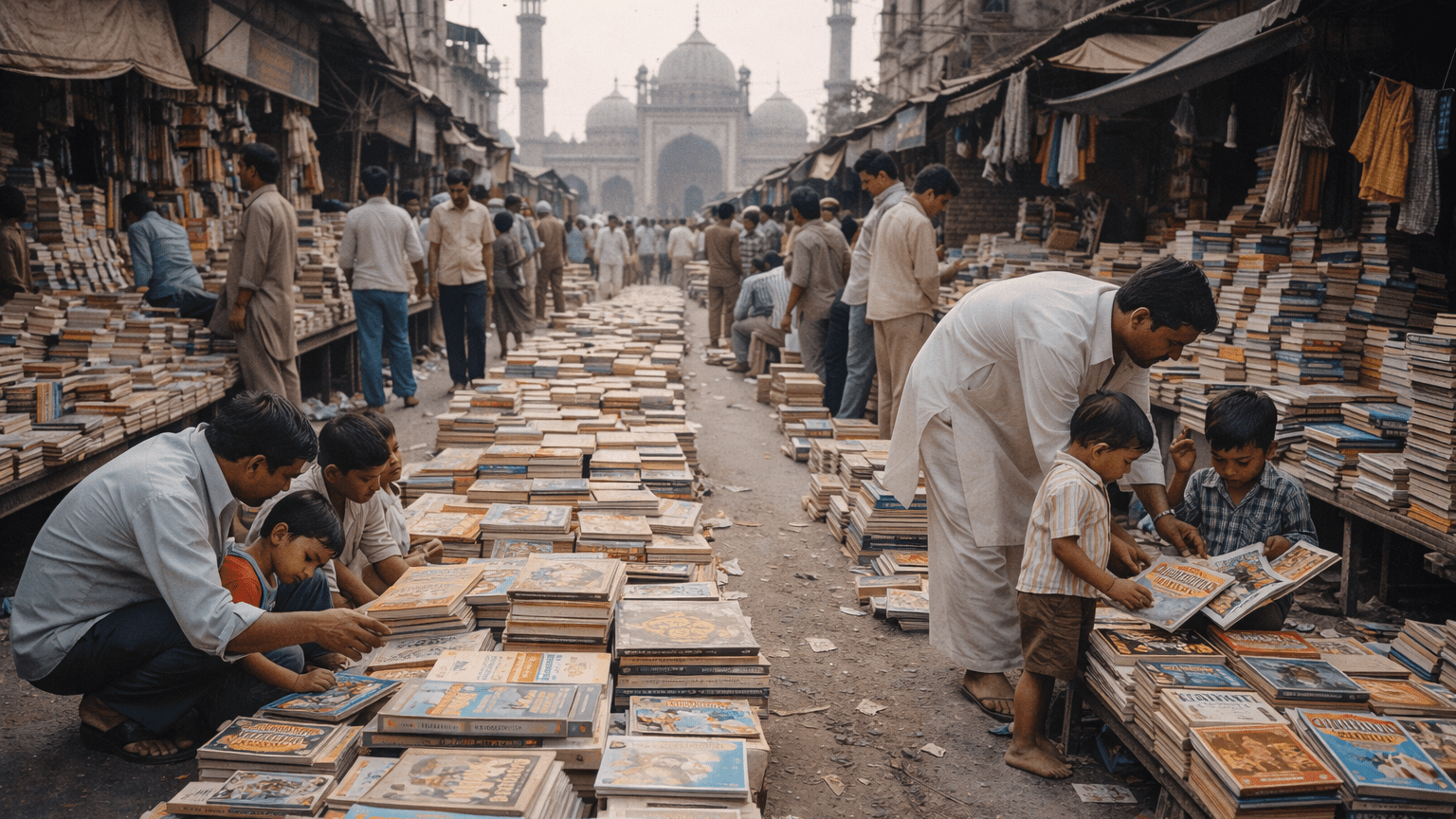
I was six or seven when my father began taking us during summer vacations to a market behind Jama Masjid that we used to call Kabaari Bazaar. That bazaar was not a fancy place. It was crowded, noisy, dusty, and full of bundles. There I used to find second-hand children’s books and magazines in bulk, unbelievably cheap.
Ten to twenty copies in one rupee. Chandamama, Lot Pot, Indrajal Comics, Panchtantra, etc. – names that still sound like the soundtrack of the 1970s. We would come back with a loose bundle, and those ten or twenty magazines would last almost two full months of summer holidays. That is what made them precious. They were not consumed in one evening. They became part of the season. Each day had a page waiting, each afternoon had a new story, each quiet moment had a new world to enter.
The city changed, and the book trails changed with it.
I remember that market later shifting behind the Red Fort, sometimes known as Chor Bazaar. Then, over time, a dedicated stretch of second-hand books started appearing on the footpath of Dariyaganj on Sundays.
Delhi, in my memory, is not only roads and monuments. It is also these moving stations of reading, these shifting rivers of books that keep flowing even when everything else changes.
By secondary school, reading was no longer only a summer pleasure. It became a companion in ordinary days.
I used to visit the Delhi Public Library on the first floor of a ‘barat ghar’ (community center) near Tikona Park, on the road going towards Gole Market. Even now I can picture the stairs and that feeling of stepping into a calmer air.
There I found old story books, Hindi books, and even Hindi versions of Shakespeare. I used to get books issued and bring them home. The act felt almost ceremonial, like borrowing a lamp for my room, a lamp that I had to return but whose light stayed inside me.
Later I became a member of the Ramakrishna Library, which felt like a real library of old books, serious and steady. I still remember how I used to find good old books of physics and chemistry there. And what remains most vivid is the separate building meant for students, where members could bring their own books and study in peace.
I am talking about my time in 1978 to the early 1980s. I genuinely do not know whether this kind of facility still exists in 2026, but in my memory it stands like a protected space for concentration, a rare gift in a city full of noise.
In one college, book stores at Nai Sarak near ‘bad sabula ped’ became a place for college books. At that time, I purchased a book in 3 pounds costing Rs. 50 approx.
In 1984, when I was in NHMC, another important part of my reading journey became routine, almost like a pilgrimage. B. Jain Publishers, on thefirst floor of a house in Paharganj, was near my home, and I was a regular visitor there. It came naturally because it lay in between my way to Ramjas School and home, just a small walking distance through the streets. I did not need a special plan to go there. I only needed time and curiosity, and I always had both.
I remember “Kanta ji” there with affection, and Dr. P. N. Jain Sir. It was not only a shop, it was a familiar place where faces were known. And like every young student, I remember the sweetness of a discount. I used to get 20 percent off. That detail sounds small, but it mattered. I still remember that Allen’s Keynotes, priced at Rs. 10, I bought for Rs. 8 in 1984. That one purchase is still alive in my mind because it represents something larger. It represents a young medical student collecting tools for a future life, buying not luxury but direction.
In college days, my relationship with books became more active and more hungry. I used to visit Dariya Ganj market on Sundays almost every month. Sometimes I bought books for ten rupees. Sometimes I bought large bundles, almost kilo-wise.
Later I noticed that vendors became sharper and more aware. Bargaining became less innocent. Sometimes they would quote prices closer to new books. Yet even that made me smile, because it showed that books were never truly worthless. Even on a footpath, their worth was rising.
During NHMC days, the world expanded again. I became a member of the American Library in Connaught Place, and also the British High Commission Library, which I remember shifting locations over time – near Mavalankar Auditorium or the Red Cross building, in an AIFACS-type space, and later to its own building at Kasturba Gandhi Road. These libraries had vast collections of medical books and journals. Entering them felt like touching a larger academic universe.
In British Library, there was a reference section where books were meant to be read only inside. That taught patience. It taught respect for knowledge. But one could get photocopies of some pages if required, at one rupee per page. Again that same coin in my story – the rupee that once bought me comics now carried home medical learning. Every year they sold old books. I purchased many and later gave away many of them to my PG students in NHMC. That remains one of the quietest joys in my memory, because reading became sharing.
British Library also had art movie shows with passes. I used to collect those passes in morning and watch films in a small auditorium inside the library. Even that fits my journey. Reading was shaping my mind, and those films were shaping my eye. It all belonged to the same hunger: to understand human life from many angles.
At one film festival, I watched an art movie in ‘Vigyan Bhavan’ – When The Raven Flies…
During internship in NHMC, around 1988 and 1989, I used to visit the National Medical Library adjacent to AIIMS. Entry was easy then. Just saying “doctor” was enough.
In the basement, I found many old homeopathy books and homeopathy journals. That basement discovery has stayed with me like a symbol. Homeopathy, often pushed to the margins, was there quietly, waiting. I do not know whether homeopathy books are still available in NML today, but I know what it meant to me then: finding my own tradition inside a larger world of medicine.
Years later, even travel could not separate me from books. In 2002, during a visit to Shimla, I was free one afternoon and walking alone on the Mall Road. I found a narrow old bookshop with an old man sitting there, the kind of shop that seems to survive on patience. I browsed and found some old medical books and also one old homeopathy book. I purchased a couple. I still remember that feeling – as if the hills had offered me not only scenery but a small addition to my inner library.
Then in about 2005, something new entered my life: a modern bookstore near my working world. Crosswords opened in Galaxy Mall near my clinic. In afternoons, when I found time, I used to visit. They had built the space nicely. You could sit for long, read without hurry, and if you wished you could buy. I liked that because it felt like the old habit had found a new home. The setting had changed, but the rhythm was the same: pick up a book, open a few pages, feel the mind settle, and let curiosity lead.
In the 2010s, my PG students also became part of this flow. They used to tell me about newly published books, new editions, new authors, and I often bought those books because I wanted to stay connected to what was emerging. A teacher must keep learning, but beyond duty, I genuinely enjoyed it. Their excitement would reach me, and I would respond with the same old instinct: bring the book home.
Even now, the habit continues. In 2025 I ordered many books on self-help, history, finances, politics, religion, memoirs of army men, politicians, and more, from Amazon and Flipkart.
And nowadays if someone shares some information about a book on social media, I often end up ordering it. The marketplace has become digital, the footpath has become a feed, the shop has become a cart, but the inner movement remains unchanged. I still want to sit with ideas. I still want to listen to other minds. I still want my days to contain more than routine.
When I connect all these scenes, I see a single thread running quietly through my years.
A small boy in a summer bazaar behind Jama Masjid.
A student climbing stairs to a community center library near Tikona Park.
A young learner studying in silence at Ramakrishna Library.
A college student walking the Sunday footpath of Dariya Ganj.
A regular visitor to B. Jain in Paharganj, remembering Kanta ji and Dr. P. N. Jain Sir, counting my 20 percent discount like a small victory of student life.
An intern entering the National Medical Library with the simple word “doctor.”
A traveller finding a narrow bookshop in Shimla.
A clinician visiting Crosswords in Galaxy Mall in the afternoon.
A senior reader still ordering books because a post on social media sparked curiosity.
Reading, for me, never remained a pastime. It became a way of staying alive inside life.
It gave me company when the world was loud.
It gave me courage when questions felt heavy.
It gave me humility, because the more I read, the more I understood how wide the world is.
And perhaps this is the most honest line I can say about it: I did not merely find books. Again and again, in different places and different years, books found me.
This is a beautiful piece of writing!
Your journey through the ‘moving stations of reading’ in Delhi is so nostalgic and heart-touching.
It is wonderful to see how the Daryaganj Sunday market still remains a cornerstone for book lovers, bridging the gap between generations of readers.
I was particularly amazed to read about you buying Allen’s Keynotes for just 10 rupees (and even getting a discount on that!) — in today’s world, it’s almost impossible to believe books were ever that accessible.
Thank you for sharing these precious memories; they remind us that while the way we buy books changes, the hunger for knowledge remains the same.
Thank you so much, Dr. Shubhanshi Bhasin, for your generous words. I am truly grateful that this memory-journey touched you. When I wrote it, I felt again those humble footpaths of books in Delhi, and I realized how quietly they shape a child, then a student, and finally a lifelong reader.
Yes, the prices have changed, the marketplaces have changed, but the inner hunger for learning and meaning remains the same. If this post inspires even one reader to pick up an old book, visit a library, walk through Dariyaganj on a Sunday, or share a beloved book with a younger mind, then these memories have done their work.
With warm regards,
Dr. Anil Singhal
very nice.
Dr Anil, I have always seen you as a quiet, gentle person (always hidden behind a smile). It’s great to see you mature into not only a successful doctor, but also as a very mature writer. Not everyone can pen down their thoughts so well. Have been reading quite a few of your write ups and am thoroughly impressed. Great job 👏🏻.
Keep enlightening us with your regular articles! Loads of blessings 🙏🏻🙏🏻
Thank you so much, Dr. (Mrs.) Pankaj Mukerji, for these kind and heartfelt words. I am truly grateful.
If there is any gentleness you have noticed in me, it is largely because books and good teachers quietly train our mind to listen more and speak less. Writing, for me, is simply an extension of the same habit of reading – to observe, to reflect, and to share something meaningful without noise.
Your encouragement gives me fresh energy to continue. I hope these small write-ups keep reminding all of us that learning never retires, and that even a few pages read regularly can brighten the inside of our day.
With warm regards and gratitude,
Dr. Anil Singhal 🙏
📚 Books are actually the best friends and the best companions I have ever found in my life especially about the ups and downs of 🧬 life, I was supported by best books of the world and I can name them as my basic power to win not only in the World of homeopathy not only in my family but to win myself.
The Books Like The secret, Power and Hero by Rhonda byrne and published by Simon turned my life to 360 degree in the year 2006 when I was struggling to settle my homeopathic practice from a small basement of a house of 100 square yards, waiting for one patient the whole day. Then got a chance to read The secret and since then I got my best chum my best friend giving me extreme joy and pleasure.
I personally congratulate Dr. Anil Singhal Sir for reminding my golden days….
Thanks for your FOOTPATHS OF BOOKS 📚.
Thank you so much, Dr. Vikas Singhal ji, for sharing this deeply personal and inspiring reflection. I read your comment with genuine warmth.
You have described something many practitioners silently live through – those early days of struggle, waiting for a patient, holding faith in your work, and still showing up every day. In such phases, a good book does more than motivate. It becomes a steady companion, helps us reorder our thoughts, and slowly rebuilds our confidence from within.
I am glad that books like The Secret, The Power, and Hero came into your life at the right time and gave you that inner lift in 2006. Your journey is a reminder for younger doctors that difficult beginnings are not failures, they are foundations – and persistence, guided by the right ideas, can truly change the direction of life.
I am grateful that “Footpaths of Books” brought back your golden days. Keep reading, keep growing, and keep inspiring others by sharing such honest experiences.
With warm regards,
Dr. Anil Singhal 🙏