
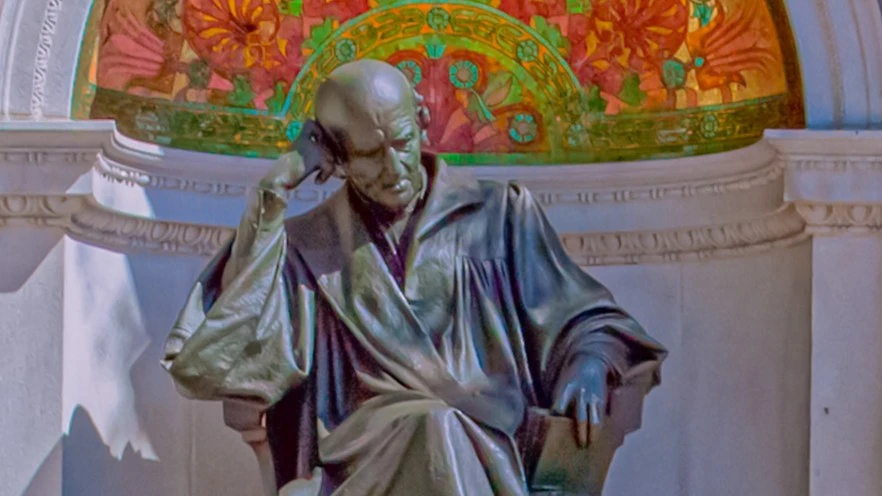
There are lessons in books, and then there are lessons in the silence between words—in gestures, in choices, in the final utterances of a life well lived. Most of what we learn from great thinkers comes long before they die, codified in doctrines, teachings, and works that are carefully preserved and passed down. But every now and then, life gifts us something rarer: a closing whisper from a soul about to depart, spoken not for applause or posterity, but out of sheer inner truth. These are not just final words—they are final teachings.
In the case of Dr. Samuel Hahnemann, the founder of homeopathy and a tireless reformer of medical thought, such a teaching came not in a lecture hall or a written aphorism, but in a quiet moment at home, in Paris, in the presence of his devoted wife Mélanie. It was not a clinical observation, nor a theoretical argument. It was a reflection of the man beneath the intellect—the soul beneath the system.
What he said, just days before he passed away, was not meant only for physicians. It was meant for all of us. You will not find it in your classroom textbooks. It is not part of any module on Organon, nor is it discussed in examinations.
Because what he offered was not a conclusion to his medical legacy. It was a message about life, suffering, humility, and the role of Providence—an eternal echo of a mind at peace with its place in the universe.
We often assume that those who have given much, suffered much, and contributed greatly to humanity must surely deserve some reward from fate—a peaceful end, a painless exit. And yet, when such a hope was spoken aloud by Mélanie, in the tender context of her husband’s suffering, Hahnemann did not accept it. His response was not only striking in its philosophical content—it was luminous in its spiritual maturity.
This moment was preserved for us by Dr. G.H.G. Jahr, one of Hahnemann’s closest disciples, and published in the Allgemeine Homöopathische Zeitung in 1843 (Volume 24, p. 258). It reads as follows:
One day, while he was once again weakened by the persistent bronchial catarrh that had gripped him since April, his wife, moved by concern, said:
“Providence surely owes you exemption from all suffering, as you have relieved so many others and have suffered so many hardships in your arduous life,”
Hahnemann replied:
“To me, why to me?
Everyone in this world works according to the gifts and powers which he has received from Providence, and more or less are words used only before the judgment seat of man, not before that of Providence.
Providence owes me nothing.
I owe all to Providence.
Yes, everything.”
These were not grand last words carved on marble, nor dictated to history with deliberate intent. They were spoken spontaneously—perhaps during a moment of quiet suffering, with Madame Hahnemann gently tending to her husband. The words do not ask for admiration. They reveal no bitterness, no expectation, and not even fatigue. They simply flow with acceptance, humility, and luminous inner clarity.
To truly grasp the magnitude of this exchange, we must step back and consider who spoke them.
This was a man who, in his youth, gave up the medical practices of his time because he felt they were doing more harm than good. A man who faced isolation, mockery, professional ruin—only because he refused to compromise on what he saw as truth. A man who translated over twenty books and wrote volumes of his own in multiple languages. A man whose search for a gentler, rational, curative system of healing led to the birth of a new science. Surely, if Providence owes anyone comfort at the end, it would be to such a soul.
And yet, he says:
“Providence owes me nothing.”
“I owe all to Providence.”
This reversal of entitlement strikes deeply, because it is so rare. In a time when we are taught to seek justice for every contribution, recognition for every effort, Hahnemann instead expresses gratitude, not grievance. He disowns any notion of cosmic repayment.
His very first line—“To me, why to me?”—is a rhetorical humility. It challenges the instinct to feel deserving. He makes it clear that he does not see himself as someone privileged in the divine order. Even after having altered the course of medicine for generations to come, he places himself not above, but among all who serve their destiny with the talents they have been granted.
“Everyone in this world works according to the gifts and powers which he has received from Providence.”
Here, Hahnemann offers a complete philosophy of life and vocation. What we call our work, our duty, even our genius, is not ours to claim—it is a responsibility given, a calling entrusted. His view resonates with ancient teachings: from the Bhagavad Gita’s emphasis on duty without attachment, to the Stoic notion of accepting one’s fate with dignity, and the Christian ideal of grace unearned.
Then comes the striking contrast:
“More or less are words used only before the judgment seat of man, not before that of Providence.”
This is a razor-sharp truth. In human society, we constantly compare—more deserving, more successful, more praised. But before Providence—before the unseen moral and spiritual architecture of life—such comparisons vanish. There is no arithmetic of reward and punishment. Only intention, sincerity, and surrender matter.
And finally, the three concluding lines come like a benediction:
“Providence owes me nothing.
I owe all to Providence.
Yes, everything.”
What greater peace can a soul express? Not regret, not demand, not self-pity—but full-circle gratitude. It is the voice of a healer who sees his life not as a ladder climbed, but as a lamp held for others. Who closes his eyes not with longing, but with contentment. Who does not bargain with God, but thanks Him.
As I read these words today—across centuries, languages, and disciplines—I do not hear a doctrine. I hear a voice. A calm, truthful voice rising above the noise of expectation. It reminds me, as a physician, that my role is not to collect titles, outcomes, or even gratitude. It is to serve with what I have, and to never mistake the source of that ability as myself.
I remember times in my practice when exhaustion mingled with discouragement—when patients doubted, or recoveries took time, or recognition seemed elusive. In those moments, like many, I found myself wondering: Have I done enough? Does it even matter? Will anyone see it? But when I come across Hahnemann’s final reflection, it shifts something within me.
Because what if our only true work is to give our best, and to be thankful we were allowed to do so? What if healing is not an achievement, but a trust? And what if Providence owes us nothing—not because it is indifferent, but because it has already given us everything we need to live meaningfully?
These questions echo within me not just as a homeopath, but as a human being walking this strange and beautiful journey of life. And I believe they will stir something within anyone who reads them, no matter their profession or path.
In the end, perhaps the most enduring legacy of Hahnemann is not only the Organon, not only the Materia Medica, not only the birth of homeopathy—but this quiet, radiant lesson from his final days. A lesson not recorded in a classroom or formal text, but whispered from one soul to another.
It teaches us:
- To serve without seeking reward.
- To live without measuring ourselves against others.
- To remain grateful in suffering.
- To bow before Providence, not question it.
And above all, to remember that our life is not something owed its dues, but something we owe in full—through love, labor, truth, and humility.
That, I believe, was the last lesson of Hahnemann. And perhaps, the greatest.
Let us live in such a way that when our work is done, we do not look back asking what the world owed us, but feel a quiet gratitude that we were given the chance to serve, to give, and to be useful. That, in itself, is life’s greatest blessing.
This is a ‘shradhanjali’ (homage) from my heart on Hahnemann’s death anniversary.
Good Morning.
I always read the lectures written by you. I love your writing, and the meaning of your writing is very meaningful, obviously I love homeopathy, I love doctor Hahnemann but the writing of you make me more closer to homeopathy and doctor Hahnemann.
So, I appreciate, I love your writing your dedication and your love towards homeopathy.
I expect, Inshallah, I will meet you very soon as soon as possible, great lover of doctor Hahnemann and doctor Boger, I am also, and the teaching of Dr Boger.
I am a homeopathic practitioner since last 15 years, practicing from each and every method but since when I started practicing on Boger’s methodology, my prescription has changed a lot and I got the deeper level of results through the teachings of Dr Boger.
LOVE HOMEOPATHY, LOVE HAHNEMANN, LOVE BOGER.
LOVE DR. SINGHAL.
warm regards from
Dr Nabi Mubarak
Scientific Homeopathy
Dear Dr. Nabi Mubarak,
Good Morning.
Thank you so much for your deeply touching message. Your words brought warmth to my heart and a renewed sense of purpose to my work. To know that my writings bring you closer to homeopathy and to the luminous legacies of Dr. Hahnemann and Dr. Boger is both humbling and inspiring.
Your love for homeopathy, your reverence for its pioneers, and your dedication to the art and science of healing are truly commendable. It is heartening to hear that practicing through Boger’s methodology has brought you deeper insights and more meaningful results. Indeed, once we step into the depth of Boger’s teachings, our perspective as physicians transforms — from superficial symptom chasing to profound understanding of the patient as a whole.
“Love Homeopathy, Love Hahnemann, Love Boger” — these words are not just a slogan, but a lifelong path. And I am honored that you included me in that chain of love. I am simply a student of these great masters, and it fills me with gratitude to walk alongside fellow seekers like you.
Please accept my heartfelt gratitude and warmest regards.
With appreciation and fraternity in healing,
Dr. Anil Singhal, MD (Hom.)