

Yesterday afternoon, something very small happened, but it opened a very old door inside me.
I came to know that a reader, Dr. Vishnu Yadav from Vijayawada, had bought every book I have published. He had bought Boger’s Legacy in February 2024 and, as my later books appeared, he continued buying them. Until yesterday, I did not even know that somewhere far from me, one reader had been quietly walking with my writing from one book to another.
His message made me happy. But the happiness was followed by something else. It took me backwards, through years and memories, to a time when I had never thought of myself as an author.
Somewhere around 1987 or 1988, while studying BHMS at Nehru Homoeopathic Medical College in New Delhi, I wrote an article for our college magazine, Quest. There was no great plan behind it.
I was simply a student who enjoyed reading, thinking and putting thoughts into words. Looking back today, perhaps a small seed was planted there, although I did not recognise it then.
A few years later, around 1991, I bought my first personal computer.
Computers were very different in those days. There was no internet as we know it today, no Google, no smartphones and none of the easy writing and publishing tools we now take for granted. Yet that little machine opened a completely new world for me.
I began writing articles for different homoeopathic journals. Slowly, I became more comfortable not only with writing, but also with collecting information, organising it and presenting it in a form that others could understand. Words, medicine, computers and books began coming together in my life.
Then, in 1995, another important chapter began. I became part of an international homoeopathic project and grew deeply involved in its work. I worked with databases, repertories, books and large amounts of information.
Using Macintosh computers and programs such as Nisus and PageMaker, I compiled, extracted, organised and designed material for numerous books that together covered more than five thousand pages.
Those were years of intense and meaningful work.
I gave a great deal of my time, energy and thought to the project, working closely with its database and helping develop several derivative books.
In my own understanding at that time, I felt that I was part of something that was being built jointly.
When that chapter eventually came to an unexpected end, I was left with a feeling I could not easily explain.
My contribution was acknowledged, and I remain grateful for the opportunities, experience and learning those years gave me.
Yet somewhere there was also a difference between what I had felt about my role and how things finally took shape.
Many years have passed, and every story can be seen from more than one side.
People contribute to a project in different ways, carry different responsibilities and may understand the same situation differently. But I can now recognise what that experience quietly left inside me.
It was not anger. It was not bitterness. Perhaps it was more like an old bruise.
A bruise does not remain painful every day. Life moves on, and after some time we almost forget that it is there. But when the same place is touched again, even gently, we remember.
That experience did not take away my love for learning. It did not stop my clinical work, my interest in repertories, my work with computers or my desire to organise and share knowledge. But without consciously deciding it, I began moving away from the world of publishing.
Writing had continued to give me joy. Publishing had somehow become associated with hesitation.
Life, meanwhile, kept moving. I became occupied with postgraduate studies, patients, teaching and the many responsibilities that naturally come with passing years.
Around 2004, while I was in the final year of my postgraduate studies, books entered my life again in a different way. Dr. D. P. Rastogi Sir, one of the senior-most names in homoeopathy and also one of our teachers and examiners, would sometimes discuss MacRepertory and ReferenceWorks with me.
He was working on his book An Overview of Repertories for PG Students and wanted to update parts of it with information from Phoenix Repertory and other related sources. Since I had already been working closely with repertory software for many years, I could help him, and eventually I completed the required compilation for his manuscript.
For me, there was nothing extraordinary about doing that work. I was a student, and he was my teacher. When a respected teacher asked for help in an area I happened to know well, there was hardly any question in my mind about whether I should help.
I was not thinking of authorship, acknowledgement or recognition. I simply worked as a student, completed what was needed and moved on with my studies and life.
After the book was published, Dr. Rastogi Sir kindly presented me a copy with his handwritten blessings and good wishes.
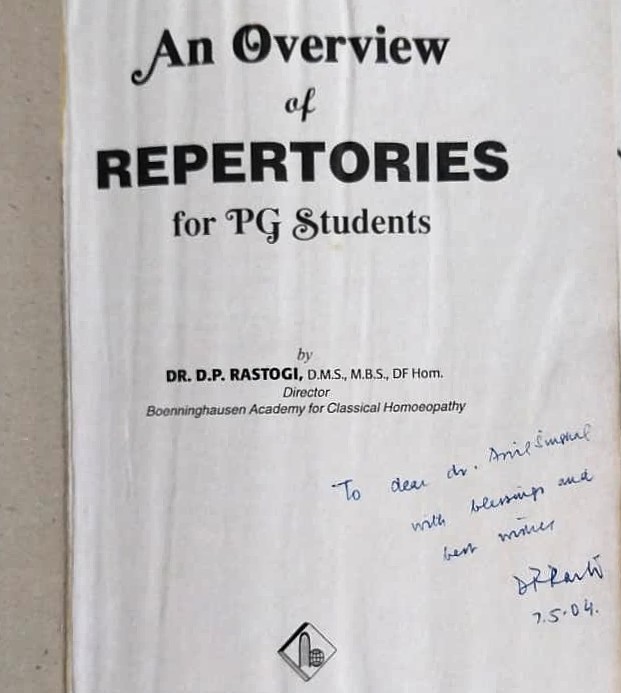
I later saw that he had also acknowledged my assistance in the book.
I still treasure that copy, not because my name appeared there, but because it reminds me of something very simple – there are times when learning, helping a teacher and contributing to meaningful work are themselves enough.
Perhaps that experience also helped me understand something much later. Recognition had never been the reason I worked. What mattered to me was the relationship between the work, the understanding with which it was done and the feeling left behind afterwards.
Then, around 2011, I received a call from a homoeopathic publisher who asked whether we could work together. Many people might have seen it as an opportunity, but I refused.
At that time, I did not think deeply about why I said no so easily. Looking back now, I feel that the old bruise was probably still there. I had moved ahead in life, but some part of me simply did not want to enter that world again.
Years passed, and then came the COVID pandemic. The lockdown suddenly gave many of us something we rarely have in ordinary life – long stretches of time with ourselves.
During those months, I opened my old postgraduate thesis again. As I went through it, I realised that some of the information I had collected and studied years earlier could still be useful to students and practitioners. It seemed unfortunate that all that work should remain locked inside a thesis on a shelf.
For the first time in many years, I seriously thought of publishing a book of my own.
The way forward was not immediate.
I approached a few publishers, but for different reasons the manuscript could not move forward at that time.
None of these situations was unusual in itself. Every publisher has its own plans, limitations and priorities, but for me the familiar feeling of waiting had returned.
This time, however, something inside me responded differently.
Instead of putting the manuscript away, I decided to publish it myself.
That decision finally brought Boger’s Legacy into the world in September 2023.
Even then, I was not fully convinced that publishing books was something I wanted to keep doing. I thought that perhaps I had simply completed one unfinished responsibility by bringing my thesis work to students and practitioners.
Around that period, there was also a feeling at home that I should spend less time managing the many small matters connected with self-publishing and give more of myself to my clinic, patients, study and actual writing.
I understood that concern.
When an established publishing route became available, I felt that perhaps placing the work in other hands would allow me to return quietly to what I loved most.
For me, the financial side of publishing had never been the main attraction. What interested me far more was the possibility that useful work might reach a student, a doctor or a reader somewhere. So after completing my part, I stepped back and returned to my usual life.
As time passed, however, I heard very little about the progress of the book or how it was reaching readers.
Later, another manuscript progressed slowly, and some articles and writings that I had been regularly sharing through different platforms also began taking a different course from what I had expected.
None of these things was serious on its own.
Publishers, journals and editors have schedules, priorities and circumstances that an author may never know. I understood that, and I still do.
But when several such experiences came together during the early months of this year, they made me stop and think.
I realised that, without noticing it, I had once again begun waiting.
I was waiting for responses and decisions.
I was waiting for a manuscript to move forward.
I was waiting to know whether something I had written would find a place somewhere.
Slowly, that familiar feeling returned.
But this time, something very important had changed.
The old feeling did not make me withdraw.
It made me think.
Why should I always wait before sharing something I genuinely feel is worth writing?
Why should the life of an idea depend entirely on whether someone else has space for it today, next month or next year?
Those questions were not born out of anger. They were born out of clarity.
I began to understand that I did not need to write for a publisher.
I did not need to write for an editor.
I did not need to write to prove that I could write, and I certainly did not need to write merely to see my name somewhere.
I could write because writing itself gave me satisfaction.
I could write from what I had seen in my clinic, what I had learnt from my patients, what I had studied over the years and what I wished someone had explained to me when I was a student.
I could write for my students, for practitioners, for my patients and for readers who might find something useful in those pages. And somewhere within all this, I could also write for myself – for the quiet pleasure of taking an idea from my mind and giving it a shape.
That realisation felt different from anything I had experienced earlier.
It felt like freedom.
Since then, writing has become lighter.
I can choose a subject because it speaks to me. I can work on it at my own pace. I can decide how deeply I want to explore it and how simply I want to explain it.
When I feel that a book is ready, I now know that I have more than one path available to take it to readers. I can also create a path of my own.
Five different books have now been published.
At different times, they have reached bestseller positions on Amazon, and copies have travelled to readers in India, Canada, Ireland, the United Kingdom, the United States and other places. Naturally, all this gives me happiness and encouragement.
But strangely, numbers and rankings were not what moved me most yesterday afternoon.
One reader did.
Somewhere in Vijayawada, a doctor bought Boger’s Legacy in February 2024. Later, when another book appeared, he bought that one too. Then another followed, and he continued reading.
I knew nothing about it.
Yesterday afternoon, when I finally came to know, something inside me connected all these scattered years.
While I had sometimes been wondering whether I should continue writing, a reader somewhere had quietly been answering that question in his own way.
He simply kept reading.
Perhaps that is why his message touched me so deeply.
It did much more than tell me that my books had been purchased.
It took me back to the young student who wrote for Quest. It reminded me of my first computer, the journal articles, thousands of pages prepared in PageMaker, the project that ended unexpectedly, the manuscript prepared for my teacher, the opportunity I once refused, the thesis that waited for years and the day I finally decided to publish something myself.
At times, I thought that I had stopped writing.
Today, I see the journey differently.
Perhaps I never really stopped.
There were pauses. There were other responsibilities. There were years when patients, teaching and family naturally came first.
There were moments when an old experience made me cautious, and there were times when the next step depended on decisions beyond my own hands.
But somewhere underneath all of that, the same desire remained – to read, to learn, to organise, to understand and then to share.
Now I am writing again, but I am not standing in the same place from where I began.
Earlier, I was often looking for a place for my writing.
Today, I am creating that place myself.
Earlier, an old bruise sometimes made me move away from publishing.
Today, that same memory reminds me why freedom matters.
I do not know how many more books I will write. I do not know which ideas will become books and which will remain unfinished pages on my computer. I also do not know where those books may eventually travel.
But I know that ideas are still coming.
I know that I still feel happy when an empty page slowly begins to fill with thoughts.
I still feel the same curiosity that made a young student write something for Quest almost four decades ago. And somewhere, perhaps in a city I have never visited and in a home I will never see, there may be another reader holding one of those pages.
Life sometimes takes us away from something we love.
A disappointment may make us pause, and a difficult experience may leave a bruise that remains with us much longer than we realise.
But a pause is not always an ending, and one difficult path does not mean there is no other road ahead.
Sometimes we need years before we understand what an old experience was trying to teach us.
And sometimes, when we finally return to the same place, we discover that we are no longer the person who once stood there.
I may still remember the old bruise, but it no longer decides my journey.
I had stepped away for a while, but eventually I found my way back.
This time, I did not return looking for recognition or permission.
I returned with something much more precious.
I returned with freedom.
Dr. Anil Singhal MD (Hom.)