
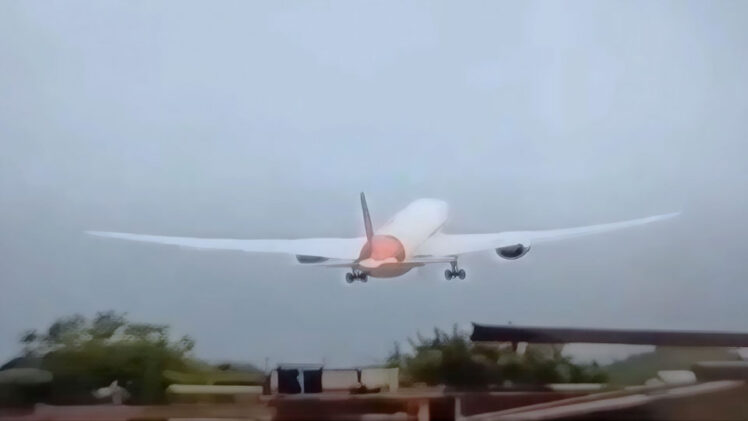
The news came to me through television—bright with urgency, sharp with pain. It was not a whisper of silence that arrived first, but a wave of sound. Breaking visuals, looping footage, stunned voices reporting from the edge of wreckage. For two days, I found myself absorbing more than I wished to see—images of fire, twisted metal, crumpled buildings, people searching rubble for anything left.
Not just in India—channels from the UK, the US, across the world were echoing the same visuals. It was not just information. It was insistence. The incident entered my space, not as news, but as a presence. And once it entered, it refused to leave.
I do not know what exactly it was that held me. I had no personal ties to those who died. Yet I could not look away. It was not curiosity. It was not mere sadness either. It was something more complex—like a heavy fog in my chest that asked me to pause and sit with it. Not just to know what had happened, but to feel it.
As the names of the deceased began to appear, as photos came in—smiling faces, glimpses of lives just moments before their end—I felt an unusual kind of closeness. These were people who had no reason to meet each other. A plane in the sky. A hostel on the ground. Two unrelated groups. Yet somehow, fate—or something beyond fate—brought them together to breathe their last in a single moment.
I found myself lingering on that detail: people from different places, different states, different ages, all converging at one fatal second. Some were mid-flight. Others mid-meal. Some likely had no idea what happened. Their lives ended before their minds could register the moment. What had been routine—traveling, dining—was transformed into their final chapter. That idea unsettled me more than I expected. It stirred a memory—not of any one tragedy, but of many.
I began to remember other times I had sat like this, watching other disasters unfold—on television, in newspapers, in sudden phone calls. A temple stampede. A derailed train. A bomb at a busy station. The scenarios differ, but the feeling repeats: people living ordinary lives until, suddenly, they were not. It reminded me of the night I watched a major attack years ago, with gunmen storming hotels, cafés, and railway platforms. The visuals of fear, of confusion, of lives torn apart mid-sentence. Then, too, I had asked: why these people? Why this time?
No answer had come then. No answer came now.
Only the growing awareness that such events are not isolated. They are part of a pattern I do not fully understand. Sometimes it is terror. Sometimes mechanical failure. Sometimes weather. Sometimes a strange alignment that defies categorization. But in each, there is the same echo: people who should never have met, dying together in a choreography none of them designed.
This time, something felt different. I am not younger anymore. I am not watching as a distant viewer. I am watching as someone who now carries years of living, of practicing medicine, of holding the hands of patients and families through illness and loss. I am no longer simply reading headlines. I am reading human endings.
And somewhere in this shift, I found myself returning to one question again and again: What brings unrelated lives to a single point of destruction?
I have no theological answer. I did not want to speak of karma, of cosmic punishment, of divine tests. I only wanted to understand, through the lens of human consciousness, what could possibly draw these individuals—people with birthdays, promises, annoyances, secrets, dreams—into the same final minute.
A part of me couldn’t help thinking about the woman who missed that flight. The one who was caught in traffic. An ordinary delay that turned out to be extraordinary. I imagined her earlier anger—cursing the jam, checking her watch. Then the stillness when she heard what she had just escaped. Did she feel spared? Did she feel chosen? Or did she feel haunted?
I wondered whether she had ever resented such delays before. Maybe she had always seen traffic as an inconvenience. Now it was a deliverance. How often in life do the things we hate become the very things that save us?
And then, I thought about the man who survived. He was on that flight. He saw the flames. He moved through them. His seat was beside the emergency exit. He acted quickly and emerged—alive, alone. The only survivor. I imagined the view from his eyes—the screams, the heat, the crumpling of the world. And then, the silence.
What does a person do with that kind of survival? Not metaphorical survival—actual, harrowing, singular survival. Does he feel thankful? Does he feel guilty? Does he wonder why seat 11A, why not 12C? Does he wonder what this life now asks of him?
I didn’t want to think of this man as lucky. I wanted to think of him as chosen—but not in the romantic sense. Chosen for something heavier: to carry the memory of the unspeakable, to hold the weight of so many voices now stilled. I imagined him being interviewed, offering facts, but knowing deep down that his real work is not to describe what happened—but to live in its wake.
And in his story, I saw a mirror—one that reflected not only what I was thinking, but what I hadn’t yet dared to feel.
I couldn’t stop thinking about him—the man in seat 11A—and her, the woman caught in traffic. Two people saved, in different ways. One by circumstance. One by decision. One spared from boarding. One spared from perishing. I kept asking myself: were they just lucky? Or was something larger at play? And if there was something larger, what was it saying? What was it doing?
I’ve spent much of my life studying the human condition—first through medicine, later through homeopathy, and always through observation. I’ve seen people survive illnesses no one thought they could. I’ve also seen lives dissolve without warning. I’ve seen mothers outlive their children and children born with the wisdom of age in their eyes. And through all of it, I’ve quietly asked: Is there a design behind all this? Or is it just chance playing dice with us, endlessly?
I’ve heard people say, “It was not his time.” Others say, “God called them.” Some speak of karmic balances and previous births. And I’ve read those ideas too—studied the Vedas, listened to discourses, contemplated the soul’s journey through lifetimes. But in this moment, I didn’t want doctrine. I wanted understanding that could sit beside grief—not above it.
Because what happened that day—two separate groups of people, one in the sky and one on the ground—joining each other in death within seconds—it was too sudden, too brutal, too precise. It didn’t feel random, and yet it felt utterly beyond comprehension. I kept wondering: were they somehow meant to meet here? Had they crossed each other in another life? Had their timelines been circling this one point, this one terrible second?
I don’t have answers. Only feelings.
And among those feelings, there was another: helplessness. A kind of existential disorientation. I didn’t want to believe in a universe capable of such cruel convergence. I didn’t want to accept that so many stories could end so violently, so instantly, in one place. And yet, history shows it happens often.
Mumbai’s 26/11 attack came back to me. The blasts at CST, the siege at the Taj, the carnage at Leopold Café. People who were merely eating, walking, checking into hotels—people doing nothing wrong—slaughtered mid-action. Some were saved by delays. A train missed. A friend who insisted on a different route. Even then, I had wondered: Why them? Why there?
More recently, I had read of the Pahalgam massacre. Peoples on a vacation, journeying with fun and simplicity, cut down by bullets. Their backgrounds differed. Their destinations shared a sacred meaning. What was that moment supposed to teach? That we are not safe? Or was there some strange fulfillment of debt, some unseen contract between soul and cosmos playing itself out?
Again, I had no answers. Only deeper awareness of how fragile life is, and how quiet the universe remains in the face of our questions.
That silence—the silence of the universe—is not like the silence between conversations. It is heavier. It does not come from absence, but from incomprehensibility. It is not the silence of a sleeping god. It is the silence of something far beyond human logic. Something that doesn’t explain itself.
No divine voice thundered across the skies. No celestial message descended. There was just the smoke, the wreckage, the grief, and the silence. A silence that has nothing to offer—except presence.
I kept watching the news. The black box recovered. Investigators would study it, map the seconds, trace the trajectory, analyze the engines. They would find out what failed. They would try to fix it for the future. And I value that. I honor it. But I know something else too.
The black box cannot tell me why that woman missed her flight. It cannot explain why a man who sat beside an exit lived, while a child six seats away did not. It cannot decode the convergence of all those lives at that precise coordinate in time and space.
Science can explain how. It cannot tell me why.
And that is where I return—to the ache. The ache of meaning. The ache of unspoken words. Because what hurts me most in these events is not just the death. It is the interruption. The people mid-sentence. The people with plans for the evening. The child who never got to open the gift. The mother who never sent her message. The goodbye that was never said.
That is what haunts me. Not the scale, but the intimacy of what was lost. The microseconds in which a thousand unspoken truths evaporated. The messages unsent. The forgiveness unoffered. The love unexpressed.
And in this haunting, I saw myself.
Because I, too, have words I’ve held back. I, too, have hesitated when I should have reached out. I have paused instead of praised, delayed instead of delivered, rationalized instead of hugged. And if something like this were to happen to me—would I be ready? Would my life feel complete? Would my heart feel emptied of its burdens?
The answer, painfully, is no.
And that “no” has lived in me like a soft burn since this tragedy unfolded. It has moved beneath my thoughts, weaving through my actions, asking me gently but persistently: What have I not yet said? What truths have I buried beneath routine?
This awareness is not heavy in the way grief is heavy. It is not the sorrow of loss—it is the sorrow of near-miss. Of recognizing how close I might be to dying without expressing all that I have truly felt.
In the wake of this event, I looked back at the patterns—26/11, Pahalgam, Ahmedabad. Different settings. Different causes. The violence of men. The failure of machines. The randomness of nature. Yet they all share one unbearable trait: they ended lives that had no idea they were about to end.
I did not want to use religion to soothe myself. Not this time. I know that different traditions offer different answers. Some say it’s karma. Others say the will of God. Some speak of moksha, others of heaven. But in the aftermath of this event, I wasn’t looking for metaphysics. I was looking for meaning that lives in the now. In breath. In eye contact. In unfinished conversations. In the decision to speak with honesty before silence makes that impossible.
I thought of the woman who didn’t board because of traffic. I thought of her past. Did she ever complain about delays? Did she fight with time all her life? And now, would she become grateful to every minute she had previously resented?
I thought of the man who walked out from the flames. Would he now hold his life with trembling reverence? Would every sunrise look different to him now? Would the rest of his life become a silent tribute to those who couldn’t walk with him through that fire?
I thought of myself. My own words. My silences.
And I realized something else. These events—though they happened far from me in place—had crept close in spirit. They had entered the intimate space where my own truths live. They had knocked on the doors I hadn’t opened in years. And with that knocking came a deeper discomfort.
Because I saw, very clearly, how much I still hold back.
And so this chapter is not written to mourn the dead alone. It is written to awaken the living. Myself first. Others if they wish to listen.
It is written as an invitation—not to fear death, but to respect life. Not to predict what will come, but to respond to what is here. The people I still love. The apologies I’ve delayed. The gestures I’ve postponed. The kindness I’ve rationed.
This tragedy has taught me one thing above all: no goodbye is guaranteed. The world does not always wait for closure. Sometimes it closes the page before you’re done writing. And the ink dries mid-word.
I have seen what unspoken words look like in the smoke of a burning aircraft. In the echo of a gunshot at a café. In the silence of a disrupted vacation.
And I no longer want to contribute to that silence.
So I begin, in my own quiet way, to speak. To express. To say what I feel, even if imperfectly. To love more loudly, and thank more sincerely. To take nothing for granted—not even the argument unresolved, or the smile not returned.
Because the deepest sorrow, I now believe, is not in dying. It is in dying with something still trapped in your chest.
And perhaps the sorrow is not mine alone.
Those who died that day—mid-flight, mid-meal, mid-thought—they too must have had words still unspoken. Words in their hearts. Ideas forming in their minds. Messages they intended to send. Apologies they planned to make. Hopes they carried quietly, waiting for the right moment. Now, all of it is held in an eternal hush.
Their silence has become permanent. And that is what deepens the ache—knowing that a thousand inner voices were stilled mid-sentence, and the world will never hear what they had yet to say.
So in honour of them, too, I choose to speak what I can, while I can.
To write this chapter not as a summary of grief, but as an offering of awareness.
The universe may not have spoken through this event. It may never explain why those people died together, or why others lived. But in the quiet that followed, I heard something.
It wasn’t divine. It wasn’t dramatic. It was just this:
Live deeply. Say what must be said. Hold no love back. Forgive now.
Because the words I don’t speak — Will echo the longest.
A beautiful, honest, and necessary reflection.
Thank you for writing it.
Thank you, R. Patel. Your words affirm the very reason I wrote this—to reflect honestly on what we all carry silently. I’m grateful it resonated with you.
This piece doesn’t attempt to explain the inexplicable – it honours it.
Thank you for inviting us into that sacred space..
Thank you, William. Your words beautifully mirror the intention behind this piece—to hold space for what cannot be explained, yet must be felt. I’m deeply grateful that you entered that silence with me.
Hi
You have captured the invisible ache that so many feel but cannot name….
Great writing…
Thank you, Sushma, for your kind words. It means a lot to know that the emotion I tried to express found its way into your heart—that invisible ache is what I, too, was trying to understand and honour through these words.